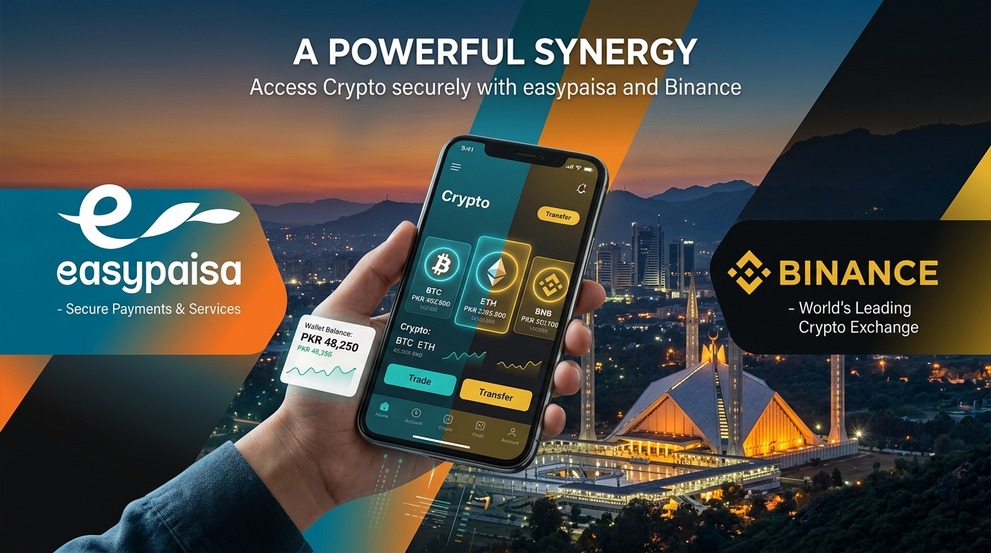
easypaisa digital bank signed an MoU with Binance on June 17, 2026, to explore digital savings and investment solutions in Pakistan. The deal follows Binance gaining AML registration from PVARA, Pakistan's new crypto regulator under the Virtual Assets Act 2026, marking a major step toward regulated digital assets in the country.
Pakistan's digital finance landscape just took a major step forward. On June 17, 2026, easypaisa, the country's first digital bank, signed a Memorandum of Understanding (MoU) with Binance, the world's largest cryptocurrency exchange. The goal is to explore new digital savings and investment solutions for Pakistani users.
This is big news. For years, crypto in Pakistan existed in a grey area, used by millions but governed by no clear rules. Now, with a formal regulator in place and a global giant working with a local bank, the picture is changing fast. Here is what it all means.
Pakistan has long been one of the biggest crypto markets in the world. With over 40 million users and an estimated $300 billion in annual trading volume, Pakistan's virtual asset market shows rapid growth, but until now it has remained largely unregulated.
That changed with new legislation. Pakistan's parliament passed the Virtual Assets Act, 2026, converting the Pakistan Virtual Assets Regulatory Authority (PVARA) into a permanent federal body with the power to license and supervise crypto service providers.
In simple terms, Pakistan moved from ignoring crypto to officially regulating it. This is the foundation that made the easypaisa-Binance deal possible.
The partnership is exploratory, meaning the two sides are studying how to work together rather than launching products immediately. Under the MoU, easypaisa and Binance will initiate exploratory discussions to assess potential areas of collaboration aimed at supporting the development of Pakistan's digital savings and investment ecosystem.
A key detail makes this credible: Binance has also obtained AML registration under the Pakistan Virtual Assets Regulatory Authority (PVARA), marking an important step in supporting Pakistan's regulated digital financial ecosystem.
AML stands for anti-money laundering. This registration means Binance is following the rules designed to keep the financial system clean and safe.
PVARA is the new sheriff of Pakistan's crypto market. PVARA is the dedicated authority responsible for licensing, supervising, and regulating Virtual Assets (VAs) and Virtual Asset Service Providers (VASPs) operating in the country.
The rules are strict. All Virtual Asset Service Providers, including cryptocurrency exchanges, wallet operators, token issuers, custodians, and investment platforms must obtain a formal license before offering services in Pakistan.
Operating without permission carries serious consequences. Criminal penalties apply to anyone operating without a license. Fines can reach PKR 50 million, equivalent to $179,000. Prison sentences of up to five years are also possible for unlicensed operations.
Here is where many headlines get it wrong. The deal and the AML registration are progress, but they do not mean crypto is fully open in Pakistan yet.
Securing AML registration allows Binance to operate within defined regulatory expectations while progressing toward full licensing. The full license, which would allow a broader set of services, is still ahead. As of now, Binance and HTX have received No Objection Certificates but are not yet permitted to fully operate in the country.
It is also worth knowing that virtual assets are NOT recognised as legal tender in Pakistan. You cannot use crypto to pay for goods the way you use rupees.
This story affects far more than just crypto traders.
For everyday users, regulation means more safety. A licensed, monitored exchange is safer than an unregulated one. Only ~21% of adults have formal bank accounts crypto offers genuine financial inclusion potential.
For freelancers and global earners, this matters a lot. Pakistan's freelancers receive payments from around the world, and regulated digital asset rails could one day make cross-border money movement cheaper and faster.
For the tech ecosystem, it is a confidence signal. When the world's largest crypto exchange engages seriously with Pakistani regulators and banks, it tells global investors that Pakistan is open for digital business.
Pakistan is not stopping at exchange registration. The government has tied crypto regulation to a wider digital finance strategy. Pakistan has also announced a Bitcoin strategic reserve and allocated 2,000 megawatts of electricity to crypto mining and AI data centers.
Industry leaders are optimistic. Binance co-founder Changpeng Zhao said Pakistan could become a global hub for Digital Assets by 2030. He linked that future to Pakistan keeping up its current pace of regulatory progress.
There is also a uniquely Pakistani element to the rules. Firms must also meet minimum capital requirements and ensure their services comply with Sharia law under the guidance of a committee of Islamic finance scholars.
The direction is clear: Pakistan is choosing engagement over prohibition. With a permanent regulator, banking access for licensed firms, and global players entering the market, the next year could bring fully licensed exchanges and new digital investment products.
For users, the smart move is to stay informed and cautious. Regulation reduces risk but does not remove it. Crypto markets remain highly volatile, and the rules are still being built.
The easypaisa-Binance partnership is a milestone moment for Pakistan's digital economy. It shows that crypto in the country is moving from the shadows into a regulated, more transparent system. While full licensing and consumer products are still ahead, the foundation is now in place. For Pakistan's young, tech-savvy population, this could be the beginning of a new chapter in digital finance.
This article is for informational purposes only and is not financial or investment advice. Virtual assets are highly volatile and carry significant risk. Always do your own research and consult a licensed advisor before investing.
On June 17, 2026, easypaisa digital bank signed an exploratory MoU with Binance to study digital savings and investment solutions in Pakistan. The deal follows Binance obtaining AML registration from PVARA (Pakistan Virtual Assets Regulatory Authority), the permanent crypto regulator created under the Virtual Assets Act 2026. PVARA licenses and supervises all Virtual Asset Service Providers; unlicensed operation carries fines up to PKR 50 million and up to 5 years prison. Binance and HTX hold No Objection Certificates but are not yet fully licensed to operate, and crypto is not legal tender in Pakistan. Pakistan has ~40 million crypto users and ~$300 billion annual trading volume, one of the world's largest markets. The government has tied regulation to a Bitcoin strategic reserve and 2,000 MW allocated for mining and AI data centers. Services must comply with Sharia law via an Islamic finance committee. Binance's CZ said Pakistan could become a global digital assets hub by 2030. easypaisa is backed by Telenor Group and Ant Group. Note: crypto remains highly volatile; this is not financial advice.