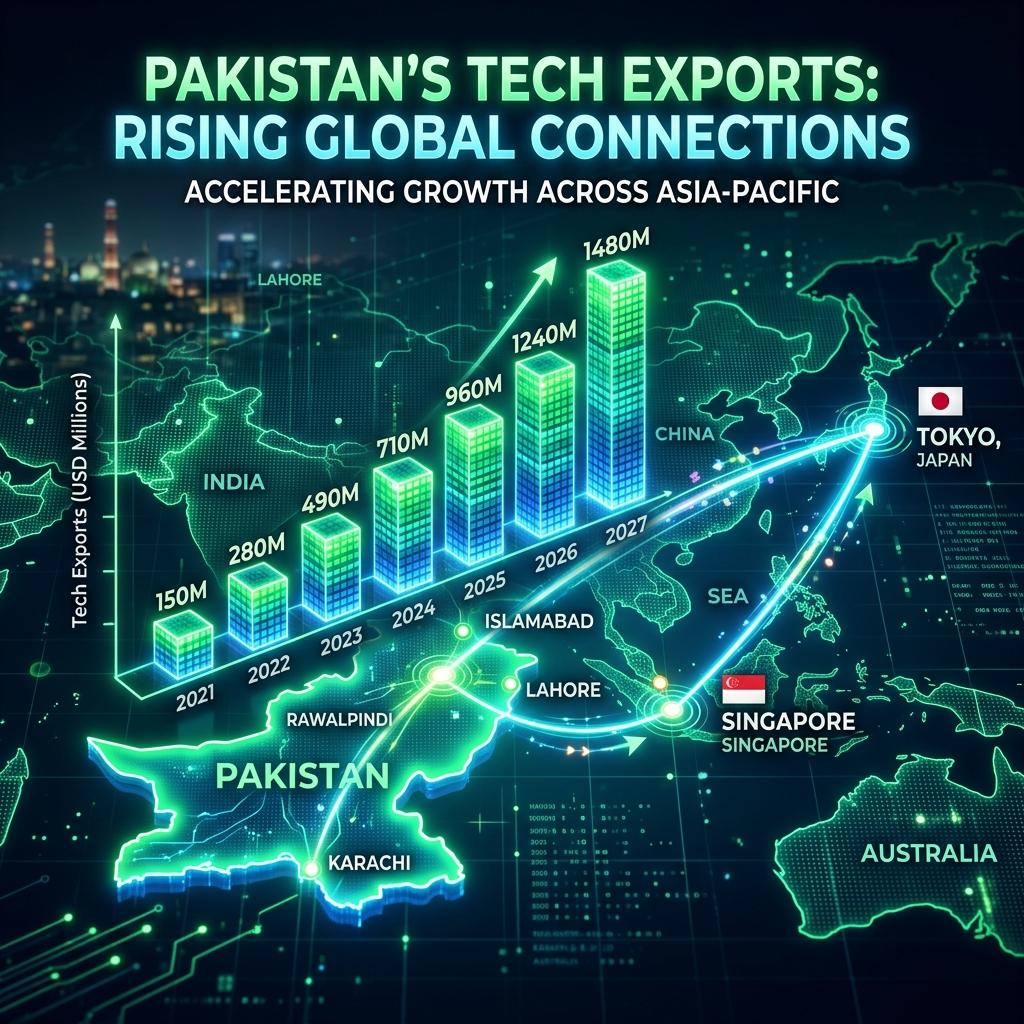
Pakistan's IT industry posted record exports of $4.6 billion in FY2025-26 (up ~21%), yet is simultaneously shedding jobs faster than in recent history. The paradox is driven largely by AI, which boosts productivity and revenue while automating routine, entry-level work. It signals a shift toward "jobless growth", more output from fewer, higher-skilled workers.
Here's a genuine paradox at the heart of Pakistan's most celebrated economic success story. In fiscal year 2025-26, Pakistan's IT industry posted its strongest performance on record, exports hit $4.6 billion, up about 21%, making tech the country's largest services export. That's fantastic news, a milestone worth celebrating.
But there's a troubling twist: at the very same time, the industry is shedding people faster than at any point in its recent history. Record revenue AND record job cuts, simultaneously. How can both be true? And what does this contradiction mean for Pakistan's workers, its industry, and its economic future? This isn't a comfortable story, but it's an important one to understand honestly. Here's what's actually going on, and what it means for you.
Let's establish the paradox clearly, because it's genuinely striking. Two things happened simultaneously in Pakistan's IT sector, and they seem to contradict each other.
On one hand, exports soared. IT and IT-enabled services receipts climbed to $4.6 billion in FY2025-26, up roughly 21% from $3.8 billion the year before. The sector is now Pakistan's largest services-export category, accounting for close to half of all services earnings. By the headline measure, it was a triumphant year (even if it narrowly missed the government's ambitious $5 billion target). On the other hand, the industry started shedding jobs faster than at any point in its recent history. So the picture is genuinely split: the money coming in is at a record high, while the number of people employed is falling sharply. Normally, we expect a booming industry to hire more people, not fewer. This inversion, more revenue, fewer jobs, is the paradox demanding explanation. And the explanation matters enormously for how Pakistan should respond.
So what's driving this strange split? The biggest factor is the same force reshaping industries worldwide: artificial intelligence. AI is the key to understanding how revenue can rise while jobs fall.
Here's the mechanism. AI tools are making IT work dramatically more productive, a smaller team, augmented by AI, can now do work that previously required many more people. AI can generate code, handle routine tasks, automate testing, produce content, and streamline processes, meaning companies can deliver more output (and revenue) with fewer workers. At the same time, AI is automating away many of the routine, entry-level, and lower-complexity roles that once employed large numbers of people, basic coding, testing, data processing, and similar work. So AI cuts both ways: it boosts the productivity and revenue of those who remain and use it well, while eliminating the need for many of the roles that used to fill IT companies. The result is exactly what we're seeing: higher output and revenue, delivered by fewer, more productive, higher-skilled people. Record exports and job cuts aren't contradictory after all, they're two sides of the same AI-driven coin.
There's a name for what's happening, and understanding it clarifies why it matters so much. Economists call it "jobless growth", when an industry or economy grows in output and revenue without creating jobs (or even while cutting them). Pakistan's IT sector is now experiencing a version of this.
Why is this such a significant concern for Pakistan specifically? Because Pakistan was counting on its IT industry to be a massive job creator for its enormous young population. The whole promise of "Pakistan's tech boom" was largely about employment, millions of young Pakistanis finding good jobs in a growing digital economy. If the industry can grow its revenue while employing fewer people, that core promise is threatened. Pakistan produces hundreds of thousands of IT graduates and trains millions in digital skills, all expecting the growing tech sector to absorb them. Jobless growth breaks that assumption. It means Pakistan could have a "successful" IT industry (by export numbers) that nonetheless fails to solve the youth-employment challenge it was supposed to address. That's a genuinely serious tension between industry success and national need, and it deserves honest attention rather than being buried under celebratory headlines.
Before we spiral into pessimism, let's inject essential balance, because the reality is more nuanced than "AI is destroying IT jobs." There are genuinely positive dimensions here too.
Several honest points. First, higher-value work is growing: while routine jobs shrink, demand is rising for higher-skilled roles, AI engineers, specialists, and those who can do complex, valuable work. The industry is moving up the value chain, which means better-paying jobs for those with the right skills. Second, more revenue per worker can mean higher wages: a more productive, higher-value industry can pay its (fewer) workers better, improving quality over quantity of jobs. Third, this is a global shift, not a Pakistan failure: AI is reshaping tech employment everywhere; Pakistan isn't uniquely affected, and adapting well could actually be a competitive advantage. And fourth, AI creates new roles too: entirely new categories of work (AI training, prompt engineering, AI implementation) are emerging. So the transition isn't simply "jobs disappearing", it's jobs transforming, from many routine roles toward fewer but higher-value ones. That's disruptive and painful for those displaced, but it's not pure loss, it's a restructuring with real opportunities for those who adapt.
This paradox affects different groups very differently, so let's be specific and practical about what it means for you. Your response should depend on where you stand.
For entry-level workers and new graduates, this is the hardest hit, the routine roles you'd traditionally start in are shrinking, so you must skill up quickly toward higher-value, AI-augmented work to enter the industry (as we've discussed, the bottom rung has moved up). For existing IT professionals, the message is adapt or risk displacement, learn to use AI to become more productive and valuable, and move toward complex, specialized work AI can't easily replace. For skilled specialists, this is actually an opportunity, demand and pay for genuine expertise (especially in AI) are rising. For companies, the path is to leverage AI for productivity while thoughtfully reskilling talent toward higher-value work, rather than simply cutting. And for policymakers and educators, the urgent task is reorienting training toward AI-era, high-value skills, and grappling with the youth-employment challenge that jobless growth creates. The common thread: in an AI-reshaped industry, moving up the skill ladder is no longer optional, it's essential. Those who do will thrive; those who don't face real risk.
This paradox has profound implications for Pakistan's economic strategy.
For the youth-employment promise, jobless growth challenges the assumption that a booming IT sector will automatically absorb Pakistan's young workforce, demanding new thinking about how to create employment.
For skills strategy, it makes reorienting education and training toward high-value, AI-era skills absolutely urgent, the old model of producing many entry-level coders is increasingly obsolete.
For the industry's future, moving up the value chain (from cheap labor toward high-value expertise) is exactly what many have long urged, this transition, though painful, could make Pakistan's IT sector stronger and more valuable.
For economic policy, it raises hard questions about how to ensure tech-sector success translates into broad prosperity and employment, not just rising export figures that benefit a shrinking, elite workforce.
The mature way to understand this moment is to hold two truths together without flinching: Pakistan's IT industry is genuinely succeeding (record exports, moving up the value chain) AND genuinely struggling with a painful employment transition (jobless growth, displaced workers). Both are real. The temptation is to pick one narrative, either celebrate the exports and ignore the job cuts, or catastrophize the job losses and dismiss the success. Neither is honest or useful. The truth is a complex, consequential transition that requires clear-eyed navigation.
The strategic wisdom flows from accepting this reality. For Pakistan, the goal shouldn't be to resist AI-driven productivity (that's neither possible nor desirable, it's what's driving the record revenue), but to manage the transition so that success translates into shared prosperity. That means aggressively reskilling the workforce toward the higher-value, AI-era roles that are growing, supporting displaced workers, reorienting education, and finding new sources of employment as routine tech work automates. For individuals, it means treating skill development as non-negotiable and moving decisively up the value chain. The countries and workers who navigate this transition best, embracing AI's productivity while proactively building the high-value skills it rewards, will emerge stronger. Pakistan has the talent and the momentum; the challenge is ensuring its tech success becomes broad-based opportunity, not just impressive export statistics. That requires honesty about the paradox, and decisive action on both sides of it. Celebrate the success, confront the struggle, and build the bridge between them.
Expect this tension, rising output with pressured routine employment, to continue and intensify as AI capabilities grow. The industry will likely keep growing in revenue and value while its employment structure shifts toward fewer, higher-skilled roles. Watch for how Pakistan responds: whether reskilling efforts accelerate, whether education reorients toward AI-era skills, and whether new high-value roles absorb displaced workers.
The optimistic scenario is that Pakistan successfully moves up the value chain, creating fewer but better jobs while its workforce reskills into them, and finds new employment engines beyond routine tech work. The pessimistic one is a widening gap between a successful-but-lean IT sector and a large, underemployed young population. The outcome depends on how proactively Pakistan manages the transition, in education, reskilling, and economic strategy. The paradox is a wake-up call: the tech success is real, but ensuring it creates broad opportunity requires deliberate action now.
The paradox of Pakistan's IT industry, record $4.6 billion exports alongside its fastest job cuts in recent history, isn't a contradiction to explain away; it's the defining challenge of the sector's AI-driven transition. AI is making the industry more productive and valuable (driving the record revenue) while automating the routine roles that once employed thousands (driving the job cuts). This "jobless growth" is genuinely great for the industry's revenue and its high-skilled workers, but it threatens the youth-employment promise Pakistan was counting on. The honest response is neither to celebrate blindly nor despair, but to navigate the transition wisely: aggressively reskill toward high-value, AI-era work, support displaced workers, and reorient education and strategy for this new reality. For individuals, moving up the skill ladder is now essential. Pakistan's tech success is real and worth celebrating, but turning it into broad prosperity, not just impressive statistics, is the work ahead. The best year ever should be a foundation for shared opportunity, if Pakistan acts decisively to make it so.
This article is an opinion and analysis piece for general informational purposes, based on data and reports available in 2026 (including State Bank of Pakistan export figures and industry reporting). It reflects perspectives on a developing situation; figures are as reported by cited sources and may vary. Individual outcomes differ. This is not career or financial advice.
Pakistan's IT industry faces a striking paradox in 2026: it posted record exports while simultaneously cutting jobs faster than at any point in recent history. State Bank of Pakistan data show IT and IT-enabled services receipts reached $4.6 billion in FY2025-26, up about 21% from $3.814 billion a year earlier, making tech the largest services-export category (close to half of all services earnings), though it missed the government's $5 billion target by roughly $400 million. Yet employment in the sector fell sharply.
How both are true, the main driver is AI: AI tools make IT work far more productive, so smaller, AI-augmented teams produce more output and revenue than larger teams could before, while AI simultaneously automates many routine, entry-level roles (basic coding, testing, data processing). The result is record revenue delivered by fewer, more productive, higher-skilled workers, record exports and job cuts as two sides of the same coin.
This is "jobless growth" (output/revenue rising without job creation, or while cutting jobs). It's especially concerning for Pakistan because the country counted on its IT boom to employ its enormous young population; jobless growth threatens that core promise, potentially producing a "successful" industry (by exports) that fails to solve youth employment.
The nuance (not all bad): higher-value roles (AI engineers, specialists) are growing; higher productivity can mean better pay for remaining workers; it's a global shift, not a Pakistan failure; and AI creates new roles (AI training, implementation). It's jobs transforming (from many routine to fewer high-value), not simply disappearing, disruptive for the displaced but with opportunity for those who adapt.
Implications by group: entry-level workers/new grads are hit hardest (must skill up fast); existing professionals must adapt (use AI, specialize); skilled specialists benefit (rising demand/pay); companies should reskill not just cut; policymakers/educators