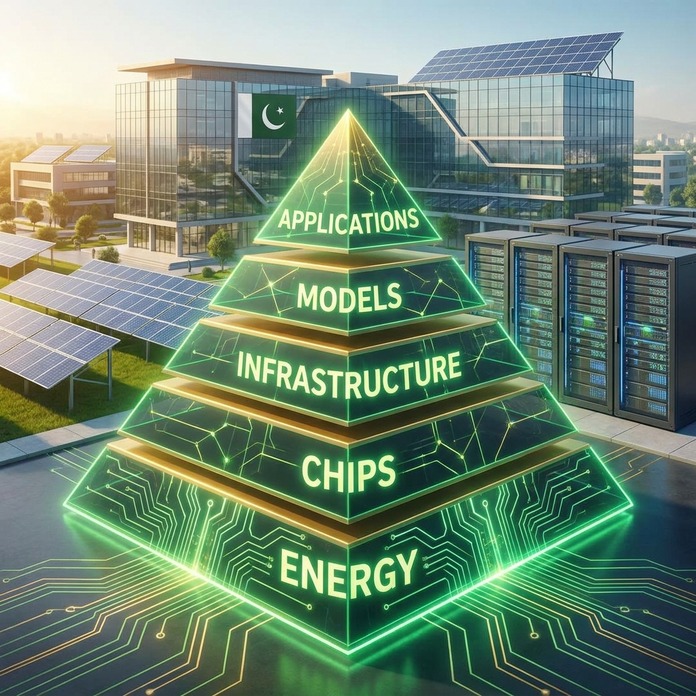
Sovereign AI means Pakistan owns its AI model weights, training data, and inference infrastructure as national assets that earn export revenue. Tech experts propose a five-layer AI stack, energy, chips, infrastructure, models, and applications, built in sequence starting with reliable power, to move Pakistan up the value chain beyond low-margin freelancing and outsourcing.
Pakistan's tech industry just hit a historic high. IT exports crossed the $4 billion mark, and freelancers alone brought in $1 billion. These are proud numbers. But this week, a different and more urgent message came from the country's tech experts: the old model is running out of road.
Their warning is simple. The cheap-labour, freelancing-first approach that built Pakistan's tech reputation is now the part most at risk from AI. To stay competitive, Pakistan must climb up the value chain and build what experts call "sovereign AI." Here is what that means and why it matters for everyone in the ecosystem.
First, the good news. Pakistan's IT sector export earnings crossed $4 billion mark for the first time during the first eleven months of FY2025-26. Freelancers added to that success. Pakistani freelancers' earnings hit $1 billion in foreign exchange during 11MFY26, underscoring their growing contribution to the national economy.
But beneath these numbers lies a problem. Much of this income comes from the lowest-margin work, the kind AI is now learning to do. As one expert put it bluntly, the days of competing only on low cost are over. Ali was of the view that labour arbitrage, an economic practice of shifting work or business operations to lower-cost regions to reduce overall labour costs, had finished.
The central argument from experts is about where Pakistan sits in the global AI economy. "Pakistan competes only at the applications layer today, the most exposed to automation."
In simple terms, the applications layer is the surface, building apps, websites, and simple tools using other people's technology. It is exactly the kind of work that AI tools can now do faster and cheaper. If Pakistan stays only here, its biggest export strength becomes its biggest weakness.
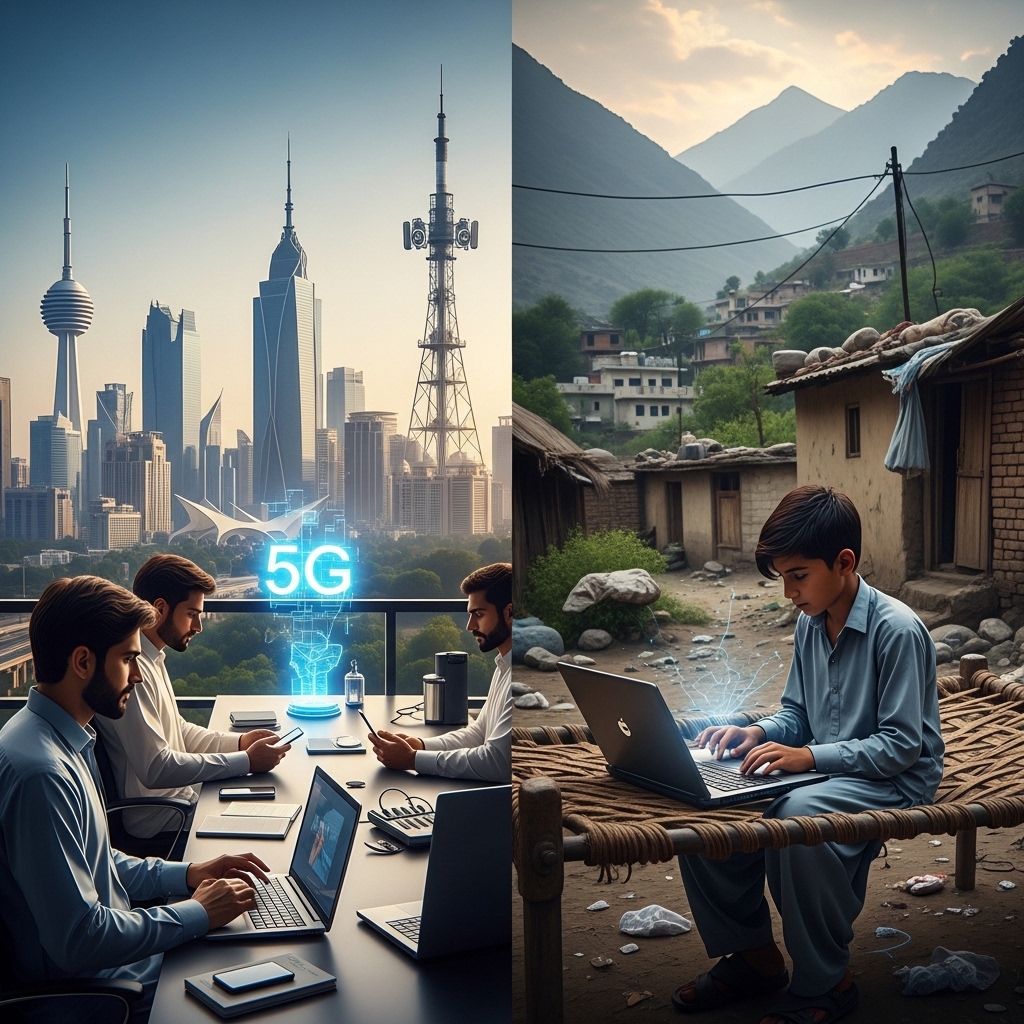
This isn't theory. The traditional freelance platforms are already shrinking. Businesses that once hired freelancers for design, writing, and coding are increasingly turning to AI tools instead, putting real pressure on the marketplaces millions of Pakistanis depend on.
The proposed solution is to build capability across the entire AI "stack," not just the top. "The protective strategy is a stack upgrade across all five layers."
The order matters more than anything. The five-layer stack runs in order: energy first, then chips and infrastructure, then models, then applications.
Why energy first? Because AI runs on massive computing power, and computing needs reliable electricity. A data center incentive package issued before the energy layer is resolved will produce empty facilities. The expert's advice is direct: fix power for technology parks first, by law, before anything else.
The goal at the top of this strategy is sovereign AI. It became a national objective earlier this year. "The Islamabad Artificial Intelligence Declaration of February 2026 frames sovereign AI as the national objective."
The definition is precise and powerful. Sovereign means model weights, training data, and inference infrastructure are Pakistani assets generating USD export revenue.
In plain language: instead of renting foreign AI and building small tools on top, Pakistan would own the core AI technology itself, and earn dollars by exporting it. That is the difference between doing the world's work and owning valuable assets.
This shift affects every part of the ecosystem.
For freelancers, it is a wake-up call. Basic gigs face the most automation risk. The opportunity is to move from simple execution toward specialized, high-value skills, or to start building products.
For developers and engineers, demand is shifting toward advanced software engineering, AI, and machine learning, the work that AI assists rather than replaces.
For founders, experts highlight specific niches where Pakistan can lead. Target verticals are Islamic finance technology, South Asian agricultural technology, and Urdu-language AI. These are markets where local knowledge is a genuine advantage no foreign company can easily copy.
For the economy, it means moving up the value chain, earning more per worker, and reducing dependence on foreign platforms and capital.
Experts are realistic about the obstacles. The biggest is the AI skills gap. Pakistan has huge raw talent but too few AI-skilled workers, and that number must rise quickly. Programs like AI Seekho, backed by Google, the Ministry of IT, and Telenor, are part of the answer, aiming to train large numbers of Pakistanis in modern AI tools.
There is also the hard reality of infrastructure. Pakistan cannot build everything alone. Bilateral compute-access agreements with Saudi Arabia and the United Arab Emirates, where the Saudi Public Investment Fund's Project Transcendence commits $100 billion to artificial intelligence infrastructure, are the realistic path.
Experts also stress that targets must be measurable. Export targets must be USD-denominated and tracked quarterly.
The direction is set, and the ambition is national. The government has committed to a major AI roadmap, including investment in infrastructure, AI education starting at the school level, and upskilling programs for both technical and non-technical professionals.
The next few years will test whether Pakistan can execute in the right order: power first, then infrastructure, then home-built models, then world-class applications. The countries that own AI assets will earn far more than those who only use them. Pakistan now has a clear map to be on the right side of that divide.
Pakistan's $4 billion IT milestone proves the talent is real. But experts are sending a clear signal: resting on freelancing and low-cost work is no longer safe in the AI era. The path forward is to build sovereign AI, climb the five-layer stack in the right sequence, and focus on niches where Pakistan has a natural edge. The talent base is ready. The question now is execution. If Pakistan builds rather than just serves, this could be the start of its most valuable tech decade yet.
In June 2026, tech experts urged Pakistan to move beyond low-margin freelancing toward "sovereign AI" using a five-layer AI stack: energy, chips, infrastructure, models, and applications, built in that order, starting with reliable power for tech parks. Speaking to Business Recorder, Liaquat Ali (LA Consulting Corporation) warned Pakistan competes only at the applications layer, the most exposed to AI automation, and that labour arbitrage is finished. Sovereign AI, framed as a national objective in the Islamabad AI Declaration of February 2026, means owning model weights, training data, and inference infrastructure as Pakistani assets generating USD export revenue. Context: Pakistan's IT exports crossed $4 billion for the first time in 11 months of FY2025-26, with freelancers contributing $1 billion. Recommended target verticals are Islamic finance tech, South Asian agri-tech, and Urdu-language AI. Challenges include a severe AI skills gap (addressed partly by Google-backed AI Seekho) and infrastructure limits, with bilateral compute-access deals with Saudi Arabia and UAE (PIF's $100bn Project Transcendence) seen as realistic paths. Experts stress USD-denominated export targets tracked quarterly. This is informational analysis, not policy or investment advice.