Pakistani freelancing is shifting from solo work toward small teams and agencies, as international clients increasingly hire collaborative units rather than individual bidders. Forming or joining a small agency lets freelancers take bigger projects, offer more services, earn more, and build something lasting. The leap requires new skills in management, delegation, and client relationships.
For years, the Pakistani freelancing dream has looked like one person: a laptop, a Fiverr or Upwork account, and the hustle to win gigs solo. That model built a billion-dollar freelance economy, and it's still valid. But something is shifting. Increasingly, international clients aren't just hiring individual Pakistani freelancers, they're hiring Pakistani teams. And the most ambitious freelancers are responding by banding together into small agencies.
Industry leaders have begun flagging this clearly: clients on global platforms are becoming more comfortable hiring Pakistani teams rather than solo bidders, and a shift toward "agency-style, team-based freelancing" is underway. This is a genuinely important evolution, and a real opportunity for freelancers ready to grow beyond solo work. Here's what's driving the shift, why forming a small team or agency could be your best next move, how to actually make the leap, and the honest challenges involved. The future of Pakistani freelancing might not be solo at all.
Let's start with the shift itself, because it's a genuine, observed trend, not just speculation. The Pakistan Freelancers Association (PAFLA) and others have noted that international clients are increasingly comfortable hiring Pakistani teams rather than only individual freelancers, and that freelancing here is moving toward an "agency-style, team-based" model.
Why is this happening? A few reasons. As Pakistani freelancers have proven their quality over years, client trust has grown, enough that clients will now engage Pakistani teams for larger, more serious work. Clients increasingly want bundles of skills and bigger deliverables (a whole project, not just one task), which a team can provide but a solo freelancer often can't. And as the freelance market matures and moves upmarket (toward higher-value work, as we've discussed), delivering complex, multi-skill projects, exactly what teams do, becomes more valuable. So the solo freelancer winning small, single-skill gigs is no longer the only, or most lucrative, model. A growing, more valuable opportunity is emerging: small Pakistani teams and agencies delivering bigger, multi-skill projects to international clients who increasingly trust and want them. For ambitious freelancers, this shift points clearly toward a new way to grow. It's the natural next stage of a maturing freelance economy.
Let's look at why forming or joining a small team/agency is genuinely appealing, because the advantages over solo freelancing are real and significant. For many freelancers, this is the logical path to growth.
Consider the benefits. You can take bigger projects, a team can handle larger, more complex work (a full website, a complete marketing campaign, an entire app) that's beyond any solo freelancer, and bigger projects mean bigger earnings. You can offer more services, combining different skills (design + development + content + marketing) lets you serve clients' full needs, win more work, and command higher value. You can earn more (and not just from your own hours), as a solo freelancer, your income is capped by your personal hours; a team lets you earn from others' work too, breaking the "time-for-money" ceiling. You build something lasting, an agency is an asset that can grow and generate value beyond your individual effort, even when you're not personally working. You reduce dependence on yourself, if you're sick or want a break, a team can keep delivering (unlike solo work, where everything stops). You can move upmarket, teams can deliver the higher-value, complex work the market increasingly rewards (and that AI can't easily replace). And you gain stability and support, collaborating with others provides backup, shared learning, and resilience. So going beyond solo isn't just about more money (though it is that); it's about building something more scalable, stable, valuable, and lasting than solo freelancing allows. For freelancers hitting the ceiling of what they can do alone, it's a genuinely compelling next step.
Here's the practical heart, how do you actually go from solo freelancer to running (or joining) a small team or agency? It's very doable, and you can start small. Here's a sensible path.
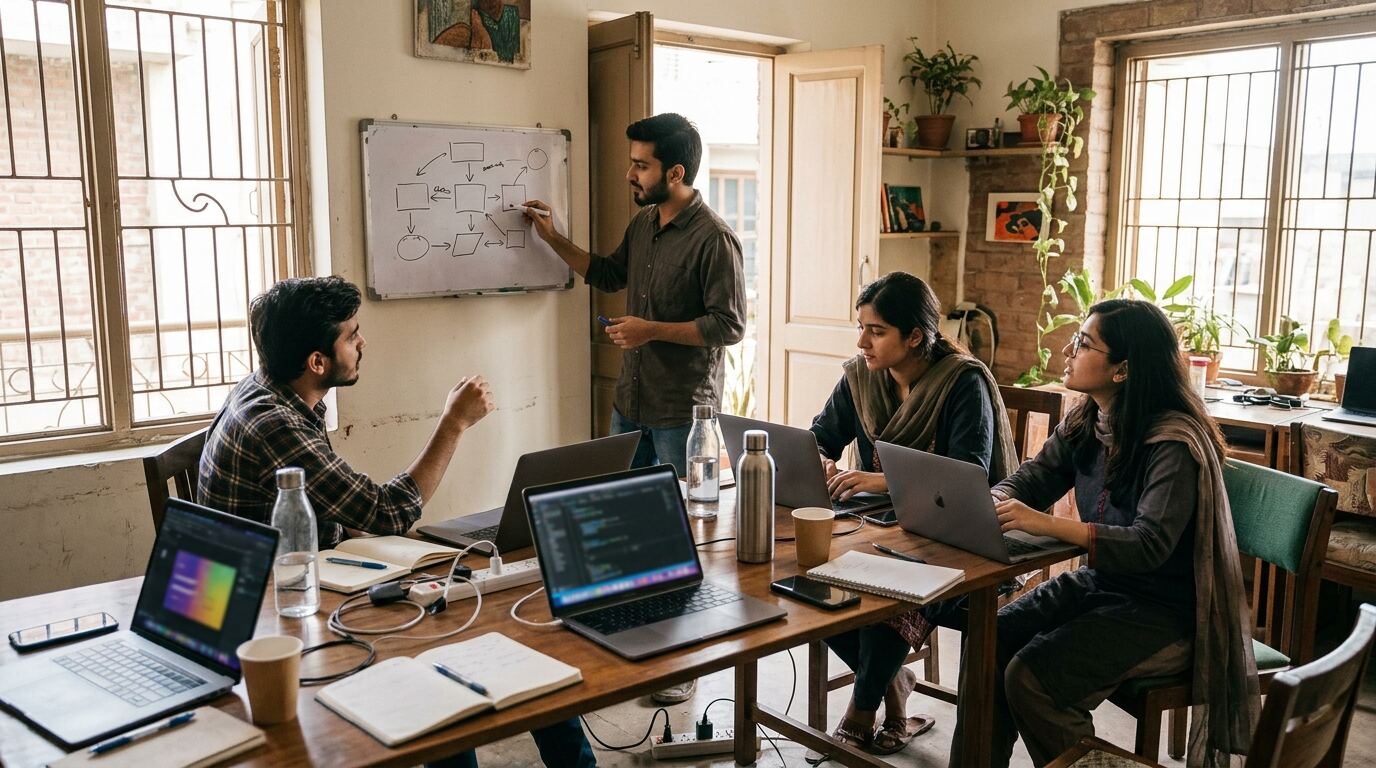
Practical steps: Start small and organically, you don't need to launch a big agency overnight; begin by partnering with one or two other skilled freelancers (complementary skills) on projects, or subcontracting overflow work to trusted peers. Combine complementary skills, team up with people whose skills complement yours (e.g., if you're a developer, partner with a designer and a content writer) so together you offer a complete service. Build trust with your collaborators, work with reliable, skilled people you trust (reputation and reliability are everything); start with small collaborations to test the fit. Take on a bigger project together, pitch for (or accept) a larger project that needs your combined skills, and deliver it well as a team, this proves the model and builds your track record. Develop light processes, as you grow, create simple systems for how you divide work, communicate, handle clients, and ensure quality. Decide on structure and fairness, agree clearly on roles, responsibilities, and how you split earnings, fairness and clarity prevent conflicts. Keep your clients central, maintain strong client relationships and communication (often one person leads client-facing work); clients should feel they're getting a reliable, professional team. And grow gradually, as you win more and bigger work, you can formalize into an agency, bring in more people, and scale. The key: you can evolve from solo to team incrementally, starting with simple collaborations and growing as it works. You don't need capital or a big leap, just the right partners and a willingness to build. Many successful Pakistani agencies started exactly this way: skilled freelancers who teamed up.
Not everyone wants to build and lead an agency, and that's fine, there's another way to benefit from this shift. If running a team isn't for you, you can join an existing one.
Here's the point. Building and leading an agency requires business and management skills (and appetite) that not every freelancer has or wants, and that's completely okay. An excellent alternative is to join a growing Pakistani freelance team or agency as a skilled member. This lets you benefit from team-based work (bigger projects, stability, learning, steady work) without the burden of running the business, you focus on your craft while someone else handles management and clients. As more Pakistani agencies form and grow, they'll increasingly need skilled people, creating real opportunities for freelancers who'd rather be great team members than business owners. So the "team" shift benefits two types of people: those who want to build/lead agencies, and those who'd rather join good ones. Both are valid, valuable paths. The key insight is that solo isn't the only option anymore; whether by building or joining, team-based work is an increasingly attractive and available path for Pakistani freelancers. Choose whichever fits your temperament and goals.
Balance matters, so let's be realistic about the challenges, because moving to team-based work isn't effortless, and it's not right for everyone. Several honest difficulties apply.
Real challenges: It requires new skills, running a team/agency demands management, delegation, communication, client relationships, and basic business skills, quite different from your craft; you have to learn these (or partner with someone who has them). People management is hard, coordinating others, ensuring quality, handling disagreements, and keeping a team reliable is genuinely challenging. Trust and reliability risks, your reputation now depends on your teammates too; an unreliable partner can damage client relationships, so choosing the right people is critical (and hard). Fair arrangements matter, unclear or unfair splits of work and money cause conflicts that can break up teams; clarity and fairness are essential. It's more complex, managing clients, teammates, quality, and money is more demanding than solo work. Not everyone wants it, some freelancers genuinely prefer the independence, simplicity, and control of solo work, and that's a perfectly valid choice. And income isn't guaranteed to rise immediately, the transition takes time and effort before it pays off. So team-based freelancing is a genuine opportunity, but it's real work with real challenges, best approached thoughtfully, starting small, choosing partners carefully, and being honest about whether it suits you. It's a path worth considering, not a mandate; solo freelancing remains perfectly valid for those who prefer it.
This shift toward team-based freelancing has broader significance.
For freelancers, it opens a path to earn more, build lasting assets, and move upmarket, growing beyond the ceiling of solo work, a genuine opportunity for ambitious freelancers.
For Pakistan's freelance economy, teams and agencies can deliver higher-value, complex work, moving Pakistan up the value chain (beyond commodity gigs) and increasing export earnings per worker.
For resilience, agency-style freelancing (bigger clients, diversified teams, recurring work) is more stable and resilient than solo gig-chasing, strengthening the sector.
For the broader economy, more Pakistani freelance agencies mean more sustainable digital businesses, jobs, and foreign exchange, a maturing, more valuable freelance economy.
The key insight is that Pakistani freelancing is maturing beyond the solo model toward team-based, agency-style work, and freelancers who recognize and thoughtfully embrace this shift, by building or joining small teams, can unlock significantly more growth, value, and stability than solo work allows. This connects directly to the broader evolution we've discussed: as the freelance market moves upmarket (rewarding higher-value, complex work over cheap commodity gigs, partly due to AI), teams become increasingly advantageous, because they can deliver the bigger, multi-skill, higher-value projects that solo freelancers can't. The fact that international clients are now comfortable hiring Pakistani teams is a sign of both the market's maturation and the proven quality of Pakistani talent. It's an opening worth seizing.
The practical wisdom is threefold. First, recognize that solo is no longer the only (or most lucrative) path, team-based freelancing is a genuine, growing opportunity to grow beyond your personal ceiling. Second, make the leap thoughtfully and incrementally, start by collaborating with one or two trusted, complementary-skilled peers on a bigger project, then grow gradually into a small agency as it works (or join a good existing team if you'd rather not lead). Third, be honest about whether it suits you, team-based work requires new skills (management, delegation, client relationships) and appetite; if you genuinely prefer solo independence, that remains perfectly valid. For ambitious Pakistani freelancers, though, this shift is a genuine invitation to level up: to move from selling your individual hours toward building or joining something bigger, more valuable, and more lasting, delivering the kind of high-value work the global market increasingly wants from Pakistan. The solo freelancer built Pakistan's freelance economy; the small team and agency may well build its more valuable, resilient future. If you're ready to grow beyond solo, this is the path, approach it wisely, start small, choose your people well, and build something that outlasts your own hours. The next stage of Pakistani freelancing is here, and it's collaborative.
Expect team-based and agency-style freelancing to keep growing in Pakistan as the market matures, clients increasingly trust and prefer Pakistani teams, and freelancers seek to move upmarket and beyond solo ceilings. More small Pakistani agencies will likely form (often from freelancers banding together), delivering higher-value work and creating opportunities for skilled people to join them. This evolution should help Pakistan's freelance economy move up the value chain and increase earnings.
For freelancers, the trajectory rewards those who adapt, whether by building teams, joining them, or at least collaborating more. Solo freelancing will remain viable, especially for specialists and those who prefer it, but the growth and higher-value opportunities will increasingly favor team-based models. The broader hope is that this shift matures Pakistan's freelance economy from a mass of solo gig-workers into a stronger ecosystem of capable teams and agencies delivering serious, high-value work to the world, more valuable, resilient, and lasting. Freelancers who position for this shift now will be best placed to benefit as it accelerates.
The next stage of Pakistani freelancing isn't the lone individual hustling for solo gigs, it's increasingly small teams and agencies delivering bigger, higher-value work to international clients who now trust and prefer them. This shift, flagged by industry leaders and driven by the market's maturation and the proven quality of Pakistani talent, is a genuine opportunity for freelancers ready to grow beyond the ceiling of solo work. Forming or joining a small team or agency lets you take bigger projects, offer bundled services, earn beyond your personal hours, build a lasting asset, and move upmarket into the high-value work the global market increasingly wants (and that AI can't easily replace). You can make the leap incrementally, starting by collaborating with one or two trusted, complementary-skilled peers on a larger project, then growing gradually, or simply join a good existing team if leading isn't for you. The challenges are real (management, delegation, choosing reliable partners, new business skills), so approach it thoughtfully and honestly, and know that solo freelancing remains perfectly valid for those who prefer it. But for ambitious Pakistani freelancers, this is a genuine invitation to level up: from selling your individual hours toward building or joining something bigger, more valuable, and more resilient. The solo freelancer built Pakistan's remarkable freelance economy; the small team may well build its stronger, higher-value future. If you're ready to grow, the next stage is collaborative, and it's open to you. Team up, build smart, and grow beyond solo.
This article is for general informational purposes only and reflects trends and information available in 2026, which vary and change over time. Observations about market shifts are based on reported industry commentary and are indicative. Individual outcomes vary, and building a team or agency carries its own risks and challenges. This is not business or financial advice.
Pakistani freelancing is evolving from the solo model toward small teams and agency-style, team-based work. Industry leaders, including Pakistan Freelancers Association (PAFLA) Chairman Ibrahim Amin, have flagged that international clients on global platforms are increasingly comfortable hiring Pakistani teams rather than only solo bidders, and that a shift toward agency-style freelancing is underway. (Context: Pakistani freelancers earned a record $197 million in September 2026; the broader market is moving upmarket toward higher-value work.)
Why the shift is happening: years of proven Pakistani quality have built client trust; clients increasingly want bundles of skills and bigger deliverables (whole projects, not single tasks) that teams provide; and as the market matures and moves upmarket (toward higher-value, complex work, partly due to AI pressuring commodity gigs), teams that deliver multi-skill projects become more valuable.
Why going beyond solo makes sense: take bigger, more complex projects (and earn more); offer bundled services (design + development + content + marketing); earn beyond your own personal hours (break the time-for-money ceiling); build a lasting asset that generates value even when you're not working; reduce dependence on yourself; move upmarket into higher-value, AI-resistant work; and gain stability, backup, and shared learning.
How to make the leap (incrementally): start by partnering with one or two trusted freelancers with complementary skills (or subcontracting overflow); take on a bigger project together to prove the model; develop simple processes for dividing work, communication, and quality; agree clearly on roles and fair earnings splits; keep strong client relationships (one person often leads client-facing work); and grow gradually into a formal agency. No capital needed, just the right partners. Many Pakistani agencies started this way.
Alternative: if you don't want to build/lead an agency, join an existing grow