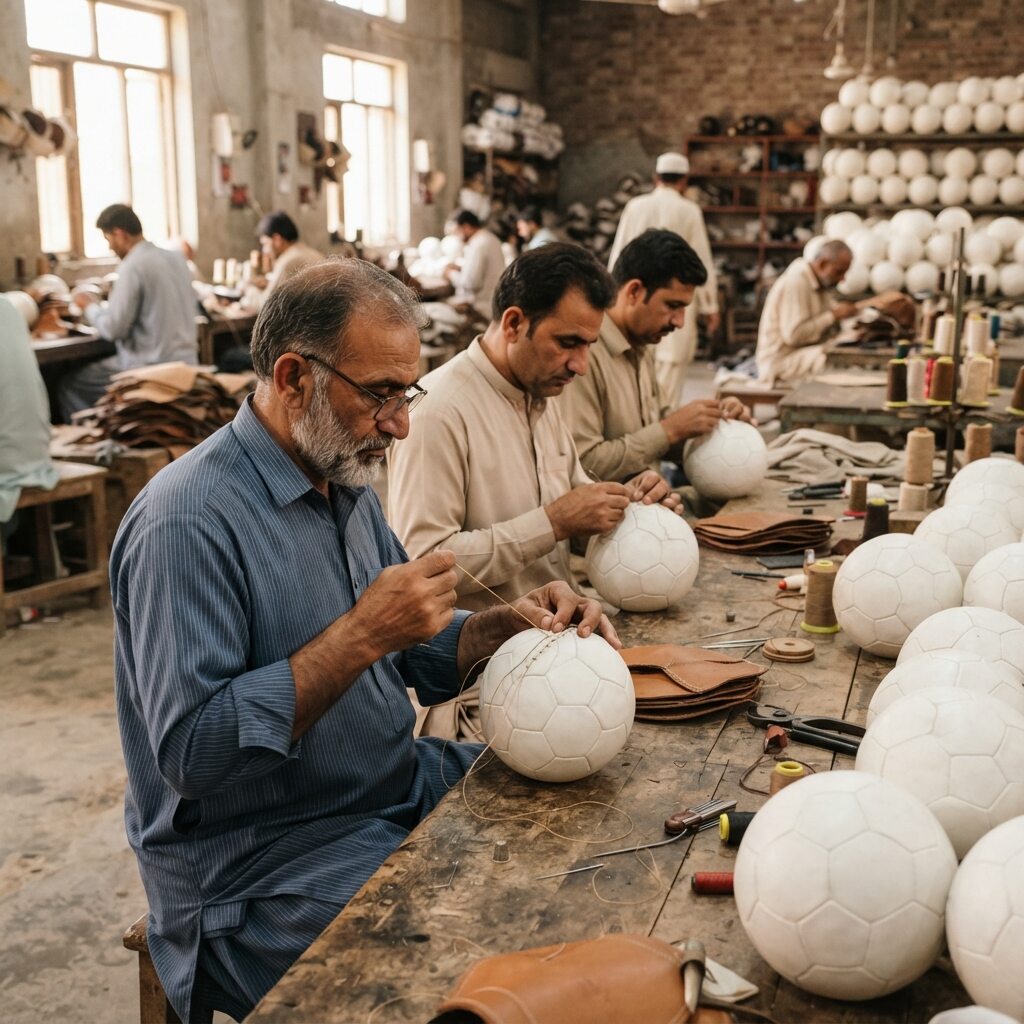
Sialkot, Pakistan produces around 70% of the world's hand-stitched footballs, exporting roughly 40 million a year to brands like Adidas, Nike, and Puma. Local firm Forward Sports has made the official FIFA World Cup match ball for four consecutive tournaments (2014-2026). The industry earns Pakistan hundreds of millions in exports annually.
Here's a fact that surprises almost everyone, including many Pakistanis. At the 2026 FIFA World Cup, when a striker curls a shot into the top corner or a goalkeeper makes a diving save, the ball at the center of that moment was made in Pakistan. Specifically, in Sialkot, a city in Punjab that quietly produces most of the world's footballs, and has made the official World Cup ball for four tournaments running.
Despite Pakistan's national team never qualifying for a World Cup, the country has been present on the pitch of nearly every World Cup for over four decades, through its footballs. It's a genuinely inspiring story, and, more than that, a fascinating business case study in how a Pakistani city built a world-dominating industry. Here's how Sialkot did it, the real economics behind it, the lessons for entrepreneurs, and the challenges ahead.
Let's start with the scale, because it's genuinely astonishing. Sialkot produces an estimated 70% of the world's hand-stitched footballs. Pakistan exports around 40 million footballs a year, with an estimated 300,000 footballs leaving Sialkot's factories every single day.
If you picked up a hand-stitched football anywhere in the world, at a school in Texas, a club in Germany, a street game in Brazil, there's a better-than-even chance it was made in Sialkot. The city supplies the biggest names in sport: Adidas, Nike, Puma, and Decathlon all source footballs from Sialkot manufacturers. And most prestigiously, Sialkot has produced the official FIFA World Cup match ball since 1982, making it the manufacturing home of the tournament's ball for more than four decades. For a single city in Pakistan to dominate a global product this completely is a remarkable, and underappreciated, achievement. It's often called, fittingly, "the football factory of the world."
At the center of this achievement is a genuine entrepreneurial success story worth telling. The company Forward Sports Private Limited was founded in Sialkot in 1991 by Khawaja Masood Akhtar, with just 20 employees and a single room.
Here's the inspiring part: Akhtar was a civil engineer by training, with no background in the football industry. His uncle ran a sports-goods business and encouraged him to try it; he wasn't initially convinced, and never imagined he'd end up manufacturing footballs. Thirty-five years later, his company produces approximately 20.5 million footballs a year and has made the official match ball for four consecutive FIFA World Cups: the Brazuca (Brazil 2014), Telstar 18 (Russia 2018), Al Rihla (Qatar 2022), and now the Trionda (the 2026 tournament across the US, Canada, and Mexico). Four consecutive World Cups, produced for Adidas, the most scrutinized piece of sports equipment on the planet, entrusted to a Pakistani company. Forward Sports also supplies footballs for major competitions like the UEFA Champions League and Europa League. It's a textbook example of how a modest Pakistani startup, built on skill and persistence, can reach the absolute pinnacle of a global industry.
This dominance wasn't built overnight, and its history holds real lessons. The story traces back to 1889, during British colonial rule, when a local Sialkot saddle-maker repaired a worn-out football for a British soldier. That small act of craftsmanship sparked something.
From there, the industry evolved steadily. Through the early 20th century, football-making grew as a local craft. During the 1950s and 60s, it transformed from a cottage industry into organized factories producing for export, and Pakistani manufacturers gradually built relationships with international sporting-goods brands in Europe. By the 1970s and 80s, Sialkot had emerged as one of the world's largest football-manufacturing centers, and in 1982, the city won its first contract to make World Cup footballs (for the Spain tournament). Over more than a century, a local repair craft became a global export powerhouse. This long arc, patient accumulation of skill, reputation, and relationships across generations, is itself a key lesson: world-class industries are usually built over decades of consistent craftsmanship and trust, not overnight.
Beyond the pride, this industry is a genuine economic engine for Pakistan, and the numbers are substantial. Football and sports-goods manufacturing brings real foreign exchange, jobs, and economic value.
Consider the figures. Between July 2025 and April 2026 alone, Pakistan exported nearly 48 million footballs, generating around $221.8 million in revenue, and sports-goods exports rose about 15.86% in the first months of FY2025-26. More broadly, Sialkot's sports industry is estimated to contribute on the order of $900 million yearly to Pakistan's economy, representing a meaningful share of national exports. Beyond footballs, Sialkot is a diversified manufacturing hub, also producing surgical instruments, cricket and hockey equipment, and more. And critically, the industry employs large numbers of people, including many women, providing livelihoods across the city. This is exactly the kind of specialized, export-oriented, employment-generating manufacturing that Pakistan's economy needs more of, real products, sold globally, earning hard currency. It's a model worth studying and replicating in other sectors.
For entrepreneurs and business thinkers, Sialkot offers a powerful lesson about how competitive industries actually get built. Sialkot's success isn't just about one company, it's about an entire ecosystem, or "cluster," of manufacturers, suppliers, skilled workers, and supporting businesses concentrated in one place.
This clustering is a genuine competitive advantage. When an industry concentrates geographically, several things happen: a deep pool of specialized skilled labor develops (Sialkot has generations of expert stitchers and craftspeople); suppliers of materials and components locate nearby; knowledge and techniques spread through the community; and the collective reputation attracts global buyers. This is why Adidas or Nike, seeking footballs, naturally turn to Sialkot, the whole ecosystem is there. It's the same principle behind Silicon Valley for tech or Sialkot for sports goods: clusters create self-reinforcing advantages that are hard for isolated competitors to match. For Pakistan, the lesson is clear and valuable: developing specialized industrial clusters (in various sectors) can build durable, world-competitive industries. Sialkot proves the model works, spectacularly.
A balanced look requires acknowledging the real challenges Sialkot faces, because its dominance isn't guaranteed forever. Pride shouldn't blind us to genuine pressures.
Several are worth naming honestly. Competition: cheaper, machine-made footballs, particularly from Chinese producers capable of mass-producing inexpensive balls, threaten Sialkot's traditional hand-stitched model, pushing some factories to guard their methods closely. Modernization: the industry has had to evolve from purely hand-stitched to machine-stitched, laminated, and thermo-bonded balls (as one manufacturer put it, "technology changes everything"), and keeping pace with technology is essential. Worker welfare: wages in the industry are low by Western standards (reports cite around $35/week for typical workers), and the sector has historically faced scrutiny on labor conditions, though major manufacturers have committed to improvements and compliance; this remains an area needing genuine attention. And value capture: Sialkot often manufactures for foreign brands rather than selling its own global brands, meaning much of the final retail value is captured elsewhere. These challenges are real, but they're also, importantly, addressable, and they point toward the industry's biggest opportunities.
Here's the exciting forward-looking part, because Sialkot's future could be even brighter if it seizes emerging opportunities. The path forward is about moving up the value chain, capturing more value, not just more volume.
Several opportunities stand out. Higher-value products: developing advanced "smart balls" (with embedded sensors/technology), premium and specialized equipment commands better margins. Own branding: building Pakistani sports brands that sell globally, rather than only manufacturing for others, would capture far more of the retail value. E-commerce: selling directly to global customers online, bypassing traditional middlemen. Sustainability: eco-friendly materials and processes, increasingly demanded by global buyers, can be a differentiator. And R&D plus government support: investment in innovation, design, and marketing (with supportive policy) could elevate the whole industry. The World Cup spotlight is a golden marketing moment. If Sialkot's manufacturers and Pakistan's policymakers seize these opportunities, the industry could evolve from a high-volume manufacturer into a higher-value, better-branded global player, capturing more of the wealth its craftsmanship creates. That's the genuine, achievable upside.
Sialkot's story carries lessons and significance well beyond footballs.
For Pakistan's economy, it's proof that Pakistan can build world-dominating, export-earning industries, a powerful, confidence-building example amid economic challenges.
For entrepreneurs, it demonstrates that Pakistani businesses can reach the pinnacle of global industries through skill, persistence, and quality (Forward Sports' journey from one room to four World Cups is genuinely inspiring).
For industrial policy, it validates the cluster model and points to the strategy of developing specialized manufacturing hubs, and the importance of helping them move up the value chain.
For national pride and image, it's a fantastic positive story, Pakistani craftsmanship literally at the center of the world's biggest sporting event, countering negative narratives with tangible excellence.
The deepest lesson from Sialkot is that world-class success comes from combining genuine craftsmanship with sustained ambition, and that Pakistan has proven it can do exactly that. Sialkot didn't dominate global football manufacturing by luck; it did so through generations of skill-building, quality, reliability, and relationship-building that earned the trust of the world's biggest brands. That's a genuinely valuable template.
The forward-looking wisdom is that the same qualities that built Sialkot's success, craftsmanship, persistence, quality, must now be paired with modernization and ambition to secure its future: embracing technology, building Pakistani brands, capturing more value, and improving worker welfare. The story also offers broader inspiration and instruction for Pakistan: if one city can dominate global football manufacturing, the country has the talent and capability to build other world-competitive industries too, with the right focus on skill, clusters, quality, and moving up the value chain. Sialkot is both a source of legitimate pride and a practical playbook. The challenge and opportunity now is to honor its legacy by helping it, and industries like it, evolve, innovate, and capture more of the value they create. Pakistan has proven it can make the world's best footballs; the next chapter is capturing the full worth of that excellence.
Watch for how Sialkot's industry navigates the coming years, whether it successfully modernizes (smart balls, advanced manufacturing), builds stronger Pakistani brands, expands e-commerce, and improves labor conditions, while defending its position against cheaper competition. The 2026 World Cup spotlight offers a valuable moment to elevate the industry's global profile and pursue higher-value opportunities.
More broadly, Sialkot's example could inspire and inform the development of other specialized export industries in Pakistan. If the country applies the lessons, clusters, craftsmanship, quality, and value-chain progression, it could build more Sialkot-like success stories in various sectors. The football industry's own future looks solid, with an opportunity to become not just bigger, but more valuable and better-branded. That evolution is the key to lasting success.
The next time you watch a World Cup match, remember: that ball was very likely made in Pakistan, in Sialkot, by skilled hands continuing a craft over a century in the making. Sialkot's dominance of global football manufacturing, producing 70% of the world's footballs and the official ball for four straight World Cups, is a genuinely remarkable achievement and a source of real pride. But it's more than a feel-good story; it's a valuable business lesson in craftsmanship, industrial clusters, export entrepreneurship, and the power of patient, quality-focused building. The story of Forward Sports, from one room and 20 employees to the world's biggest tournaments, embodies what Pakistani enterprise can achieve. Real challenges remain, competition, modernization, worker welfare, and value capture, but so does enormous opportunity to move up the value chain and capture more of the wealth this excellence creates. Sialkot proves Pakistan can build world-dominating industries. The task now is to honor that legacy by helping it, and others like it, reach even higher. Pakistan is already on the world's pitch. The next goal is to own more of the game.
This article is for general informational purposes only and reflects information and figures available in 2026; export and production numbers are as reported by cited sources and may vary. It aims to tell an accurate, balanced story including genuine challenges. This is not investment or business advice.
Sialkot, a city in Punjab, Pakistan, produces an estimated 70% of the world's hand-stitched footballs, exporting roughly 40 million a year (about 300,000 leave its factories daily) to major brands including Adidas, Nike, Puma, and Decathlon. It has produced official FIFA World Cup match balls since 1982, earning the nickname "the football factory of the world." Notably, though Pakistan's national team has never qualified for a World Cup, its footballs have been present at nearly every tournament for over four decades.
At the center is Forward Sports Private Limited, founded in Sialkot in 1991 by Khawaja Masood Akhtar (a civil engineer with no football-industry background) with 20 employees in a single room. Today it produces ~20.5 million footballs yearly and made the official Adidas World Cup match ball for four consecutive tournaments: Brazuca (2014), Telstar 18 (2018), Al Rihla (2022), and Trionda (2026, across the US/Canada/Mexico). It also supplies UEFA competitions.
History: the industry began in 1889 when a Sialkot saddle-maker repaired a British soldier's football; it grew from cottage craft to organized export factories through the 1950s-60s, becoming a global center by the 1970s-80s.
Economics: Pakistan exported nearly 48 million footballs generating ~$221.8 million between July 2025 and April 2026; sports-goods exports rose ~15.86% early in FY2025-26; Sialkot's sports industry contributes roughly $900 million yearly to Pakistan's economy, plus significant employment (including many women).
Key business lesson: the power of the industrial "cluster", concentrated skilled labor, nearby suppliers, shared knowledge, and collective reputation create self-reinforcing competitive advantage (like Silicon Valley for tech).
Honest challenges: competition from cheaper machine-made (especially Chinese) footballs; the need to modernize (machine-stitched, thermo-bonded, smart balls); worker-welfare/wage concerns (~$35/week, below Western standards, an are