The National Artificial Intelligence Advancement Initiative (NAAI) is Pakistan's plan, launched July 2026 by MoITT under the National AI Policy, to establish seven AI Hubs in Islamabad, Lahore, Karachi, Peshawar, Quetta, Muzaffarabad, and Gilgit. It aims to incubate 560 AI startups over two years and provide 150 non-dilutive seed grants.
Pakistan has just taken one of its most concrete steps yet toward building a real artificial intelligence economy, and this one comes with specific numbers, locations, and money attached. The government has launched a nationwide plan to create seven AI innovation hubs and put hundreds of startups through structured incubation.
For aspiring founders, students, and anyone watching Pakistan's tech ambitions, this is worth understanding in detail, because it moves from broad policy toward actual institutional infrastructure. Here is exactly what was announced, where the hubs will be, what the grants involve, and an honest look at whether it can deliver.
The initiative has a clear structure and an ambitious goal. The Ministry of Information Technology and Telecommunication (MoITT) unveiled a nationwide plan to establish seven AI Hubs across Pakistan under the newly launched National Artificial Intelligence Advancement Initiative (NAAI), aiming to incubate 560 AI startups, distribute non-dilutive seed grants to 150 startups, and position the country as a regional hub for AI-driven innovation.
Crucially, this is not a standalone announcement, it is implementation of existing policy. The initiative was launched as part of the implementation of Pakistan's National AI Policy, marking one of the government's most comprehensive interventions to build an institutional AI ecosystem by bringing together academia, industry, startups, researchers, investors, and the public sector under a single national framework.
That framing matters: it signals a shift from writing policies to actually building the institutions those policies call for.
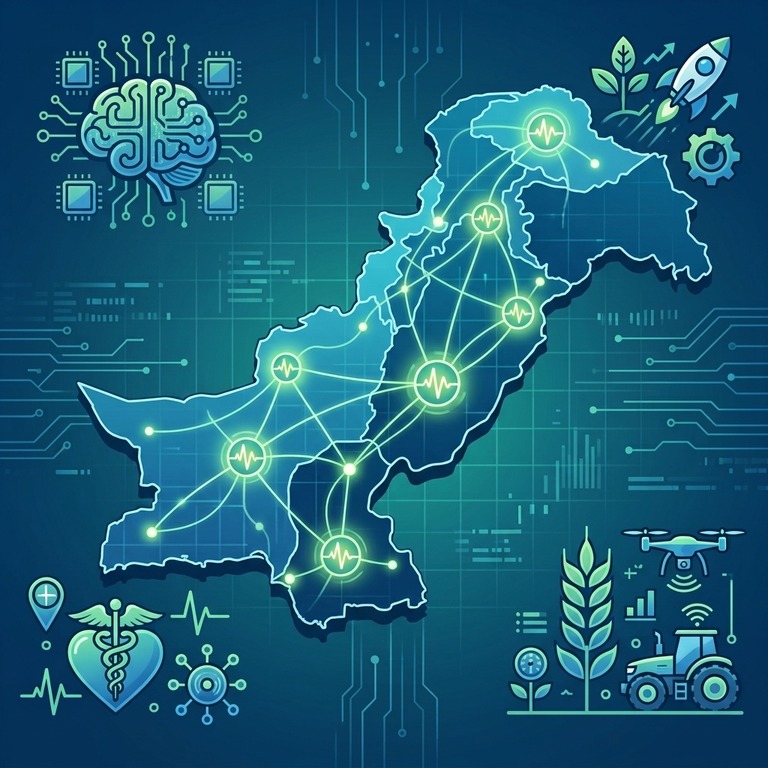
One genuinely important feature is the deliberate geographic spread across the country, not just the big three cities. According to the ministry's documents, a selected entity will design, establish, operate, and sustain AI Hubs in Islamabad, Lahore, Karachi, Peshawar, Quetta, Muzaffarabad, and Gilgit.
This is a thoughtful choice. By placing hubs not only in the major centers (Islamabad, Lahore, Karachi) but also in Peshawar, Quetta, Muzaffarabad, and Gilgit, the plan reaches provinces and regions often left out of tech investment. For talented young people in Balochistan, Khyber Pakhtunkhwa, Azad Kashmir, and Gilgit-Baltistan, a local AI hub could be genuinely transformative, opportunity that previously required relocating to a major city.
Each hub is meant to be a proper facility, equipped with modern office infrastructure, high-speed internet, collaboration spaces, mentorship rooms, and dedicated workspaces for AI startups.
The numbers behind the "560 startups" figure follow a clear structure. Under the two-year programme, each hub will induct 20 AI startups per cohort, with two cohorts every year, producing 40 startups annually per hub and 280 per year across all seven, totaling 560 over two years.
Beyond just desk space, the hubs are meant to deliver a full support ecosystem, including AI boot camps, accelerator programmes, incubation support, thematic AI challenges, hackathons, and startup mentoring. Importantly, there is a strong emphasis on commercialization: the operator must connect startups with venture capital firms, incubators, accelerators, research institutions, and technology companies to improve investment readiness and market access.
That commercialization focus is significant, because Pakistan's persistent weakness has not been creating startups, but helping them progress, find follow-on funding, customers, and paths to scale.
Perhaps the most founder-friendly element is the grant structure. One of the programme's most significant components is the administration of 150 non-dilutive seed grants for AI startups.
The phrase "non-dilutive" matters enormously for founders. It means the funding does not take equity, founders receive money without giving away ownership of their company. This is far more favorable than typical investment, where capital comes in exchange for a share of the business. For early-stage AI startups, non-dilutive grants provide crucial runway while letting founders retain full control.
The ministry has directed that the funding be merit-based, supported by clear key performance indicators, milestone-based disbursements, and robust monitoring, an approach designed to ensure the money produces real results rather than disappearing.
The initiative targets practical, high-impact applications rather than abstract research. The hubs are intended to focus on AI applications across priority sectors including healthcare, agriculture, education, fintech, public-sector governance, and smart and sustainable cities.
This is a sensible, Pakistan-appropriate list. Agriculture employs much of the population and could benefit hugely from AI-driven efficiency. Healthcare faces access gaps AI could help bridge. Fintech is already one of Pakistan's most dynamic sectors. Focusing hubs on these real-world domains, rather than chasing frontier research Pakistan is not yet positioned to lead, is a pragmatic, high-value choice.
A particularly encouraging aspect is that inclusion is built in, not bolted on. Recognizing the importance of inclusive innovation, the ministry directed that the programme ensure meaningful participation of women and individuals from rural and underserved communities throughout implementation, aligning with Pakistan's commitments under the Sustainable Development Goals.
Combined with the geographic spread to smaller cities and regions, this focus could help ensure Pakistan's AI opportunity reaches beyond the usual urban, well-connected circles. As we have covered before, when Pakistani women and underserved communities get access to digital tools, they consistently prove the barrier was opportunity, not ability. Building that access into a national AI programme from the start is genuinely smart.
The initiative creates real, tangible opportunities across the ecosystem.
For aspiring AI founders, this is a direct pathway, structured incubation, mentorship, commercialization support, and potentially non-dilutive funding to build an AI startup, without relocating abroad or to a mega-city.
For students and young technologists, the hubs, boot camps, and hackathons offer hands-on learning and entry points into the AI field, plus local career pathways.
For the startup ecosystem, the commercialization focus and investor connections directly target Pakistan's follow-on funding gap, potentially helping more startups progress rather than stall.
For underserved regions, local hubs mean opportunity arrives closer to home, which could help slow the talent drain from smaller cities to major centers, or even abroad.
Here is the honest assessment that regular readers will recognize. On paper, NAAI is genuinely well-designed. The geographic spread, the non-dilutive grants, the commercialization emphasis, the inclusion focus, and the merit-based, KPI-driven structure all reflect thoughtful planning that addresses real gaps in Pakistan's ecosystem. This is more substantive than a vague vision statement.
But, as always, execution is the real test. Pakistan has a strong record of announcing well-designed programmes and a weaker record of delivering them consistently. The initiative depends on selecting a capable operator, actually building and equipping seven hubs, disbursing grants transparently, and sustaining the effort beyond the initial two years. The plan even acknowledges this by requiring long-term financial sustainability models to reduce reliance on government funding over time, a wise inclusion, if realized.
The measures of success will be concrete: Do the hubs actually open and operate well? Do incubated startups secure real funding and customers? Do the grants reach deserving founders transparently? Those answers, over the next two years, will determine whether NAAI becomes a genuine turning point or another well-intentioned plan. The design deserves optimism; the delivery deserves scrutiny.
Watch for the operator selection and the opening of the first hubs, the first real signals of momentum. Then watch the first cohorts: which startups get incubated, whether grants are disbursed as promised, and whether any incubated companies achieve visible success. Early wins would build the credibility and momentum the programme needs.
If NAAI delivers even reasonably well, it could meaningfully strengthen Pakistan's AI ecosystem, complementing the country's data-centre infrastructure, AI policy, and investment plans with the human and institutional layer that turns ambition into companies and jobs.
The National AI Advancement Initiative is one of the more concrete and thoughtfully designed steps in Pakistan's AI journey, seven hubs across the country, 560 startups incubated, 150 non-dilutive grants, a commercialization focus, and a genuine commitment to including women and underserved regions. It moves Pakistan from writing AI policy toward building AI institutions. The design is sound and, in places, genuinely smart. The open question, as ever, is execution over time. For Pakistan's aspiring AI founders, though, the message is encouraging: real infrastructure and real opportunity are being built, and increasingly, they may be within reach wherever in the country you happen to be. Now the country has to deliver.
This article is for general informational purposes only and reflects announcements available as of July 2026. Programme details, locations, eligibility, and timelines are as reported and may change during implementation; check official MoITT channels for current information.
In July 2026, Pakistan's Ministry of Information Technology and Telecommunication (MoITT) launched the National Artificial Intelligence Advancement Initiative (NAAI) under the National AI Policy, a comprehensive plan to build institutional AI infrastructure by uniting academia, industry, startups, researchers, investors, and the public sector.
NAAI will establish seven AI Hubs in Islamabad, Lahore, Karachi, Peshawar, Quetta, Muzaffarabad, and Gilgit, a deliberate geographic spread reaching provinces often excluded from tech investment (Balochistan, KP, Azad Kashmir, Gilgit-Baltistan). Each hub will be equipped with modern infrastructure, high-speed internet, collaboration and mentorship spaces, and startup workspaces. A single selected operator (company or consortium) will design, build, operate, and sustain them.
Incubation structure: each hub inducts 20 startups per cohort, two cohorts yearly (40/year per hub; 280/year across all seven), totaling 560 startups over two years. Support includes AI boot camps, accelerators, hackathons, thematic challenges, mentoring, and, importantly, commercialization support connecting startups to VCs, accelerators, and research institutions, addressing Pakistan's startup "progression" gap.
A key component: 150 non-dilutive seed grants (funding without taking equity), disbursed merit-based with defined KPIs and milestone-based payments. Priority sectors: healthcare, agriculture, education, fintech, public-sector governance, and smart/sustainable cities.
Inclusion is built in: the ministry mandated meaningful participation of women and rural/underserved communities, aligning with the SDGs.
Honest assessment: the design is genuinely strong (geographic reach, non-dilutive grants, commercialization focus, inclusion), but execution is the test given Pakistan's pattern of strong announcements and weaker delivery; the plan requires capable operator selection and long-term sustainability beyond two years.