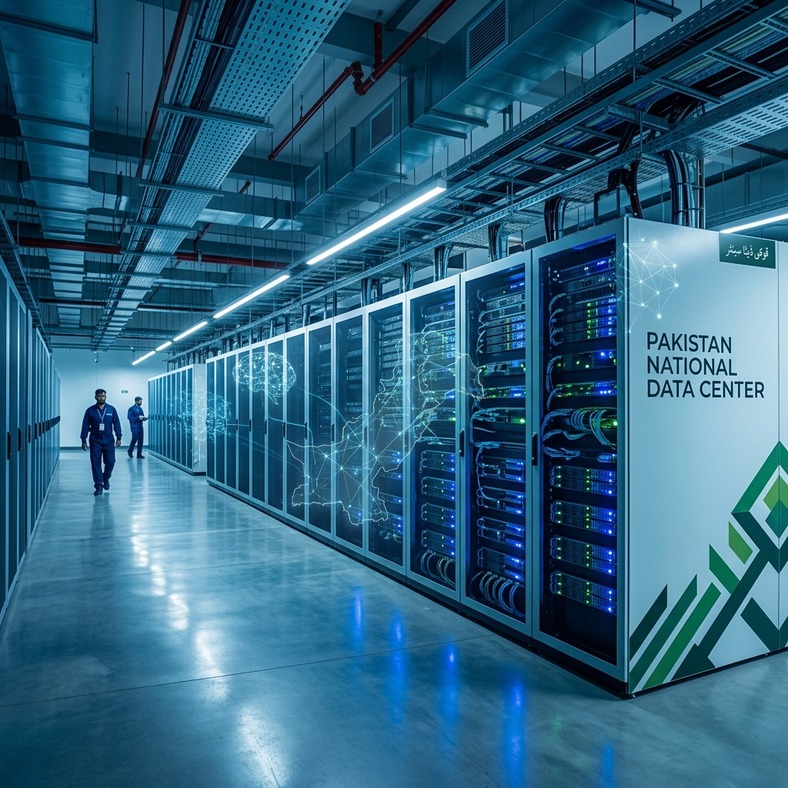
Sky47 Karakoram-01 is Pakistan's largest AI-ready data centre, inaugurated on July 24, 2026 in Islamabad. Built by Mari Technologies with China's ZTE, the 8.5-megawatt, Tier III/IV facility provides high-performance computing for AI, cloud, and secure data hosting. Its sovereign cloud keeps critical data within Pakistan, with similar centres planned for Karachi and Lahore.
Pakistan just took one of its most concrete steps yet toward becoming a real player in the AI economy, and this time it is not just a policy or a plan, but actual physical infrastructure. The country has inaugurated its largest AI-ready data centre, a facility designed to power artificial intelligence, cloud computing, and secure data storage on home soil.
This matters more than a typical government announcement, because computing infrastructure is the single biggest bottleneck holding back AI ambitions everywhere, including Pakistan's. Here is what the new data centre actually is, why it is genuinely significant, and an honest look at where it fits in Pakistan's larger AI journey.
The inauguration was a high-profile national event. Prime Minister Shehbaz Sharif, alongside Chief of Army Staff and Chief of Defence Forces Field Marshal Syed Asim Munir, jointly inaugurated Sky47 Karakoram-01, described as the country's largest carrier-neutral, AI-ready data centre, in Islamabad on July 24, 2026.
The government framed it as foundational. The Prime Minister said the facility would become the backbone of the country's technological transformation, paving the way for advanced artificial intelligence, cloud computing, secure data hosting, and next-generation digital services. The IT Minister described it as providing the foundation of infrastructure capable of producing what she called "token intelligence", the computational output that powers modern AI.
It was also built fast, which officials emphasized. The project was completed in what the government described as record time, and delivered through a partnership involving Pakistani and Chinese expertise.
Before going further, it helps to understand what this actually is, since "data centre" and "AI cloud" can sound abstract.
A data centre is essentially a highly secure, specialized building full of powerful computers (servers) that run continuously. When you use AI tools, cloud storage, or online services, that work happens on servers in data centres somewhere in the world. AI in particular needs enormous amounts of this computing power, which is why dedicated "AI-ready" facilities matter.
The key measure here is capacity. Sky47 Karakoram-01 has an operational capacity of 8.5 megawatts, referring to the electrical power available to run its computing equipment, and it is built to international Tier III/IV standards, the certifications that guarantee high reliability and near-continuous uptime. In simple terms, it is a large, professional-grade facility designed to run demanding AI and cloud workloads reliably.
The project has notable backers. Sky47 was developed by Mari Technologies Limited, a subsidiary of Mari Energies (formerly Mari Petroleum), one of Pakistan's major energy companies, marking an interesting move by an energy firm into digital infrastructure. The facility was disclosed to the Pakistan Stock Exchange as material corporate information, reflecting its commercial significance.
On the technology side, it was built in partnership with ZTE, the Chinese telecommunications and infrastructure giant. This fits a broader pattern of Pakistan-China technology cooperation, which we have seen elsewhere in Pakistan's AI and digital initiatives.
The single most important concept behind this facility is "sovereignty", keeping Pakistan's data inside Pakistan. This is the heart of why it matters.
The design centers on this principle. The project incorporates sovereign cloud architecture and multilayer enterprise security, ensuring that critical government, financial, and corporate data remains securely stored within Pakistan's borders. Officials say this will strengthen the country's digital sovereignty, improve cyber resilience, and reduce reliance on overseas data hosting.
Why does this matter? Currently, much of the data used by Pakistani businesses and even government runs on foreign cloud services hosted abroad. That creates dependence, potential security concerns, and costs paid to foreign providers. A domestic facility means sensitive data, banking records, government information, corporate systems, can be stored and processed at home, under Pakistani control. This connects directly to Pakistan's earlier move to require government data to be hosted locally.
Here is the deeper significance for anyone following Pakistan's AI ambitions. The scarcest resource in the entire global AI race is not ideas or talent, it is compute, the actual computing infrastructure to run AI.
This is not a minor point. Around the world, even companies worth hundreds of billions of dollars are struggling to secure enough computing capacity, paying billions to rent it. For a developing country, building domestic compute is exactly the hard, expensive, foundational work that ambitious AI plans require but often lack.
So a real, operational AI data centre is arguably more meaningful than another policy announcement. Pakistan has plenty of AI plans, a billion-dollar strategy, a national policy, international partnerships. What it has lacked is physical infrastructure. This facility begins to address that gap directly, which is why it deserves genuine attention.
The potential benefits reach across several areas.
For businesses and startups, local high-performance computing could mean more affordable, faster access to the infrastructure needed to build AI products, without renting expensive capacity abroad. The facility is meant to serve businesses, startups, research institutions, and government initiatives.
For government, secure domestic hosting supports digital governance initiatives while keeping sensitive national data protected at home.
For the digital economy, reliable local infrastructure underpins everything from cloud services to AI development to the country's Digital Nation vision.
For attracting investment, having real AI infrastructure strengthens Pakistan's case as a technology destination, and can attract global cloud providers to host services within the country.
For jobs and skills, building and operating advanced data centres creates high-value technical roles and builds local expertise in a critical field.
Honesty requires perspective here, and it strengthens rather than diminishes the achievement. Sky47 Karakoram-01 is a genuine, meaningful step, real, operational compute infrastructure is exactly what Pakistan needed, and building it in record time is commendable.
At the same time, scale matters for context. At 8.5 megawatts, this is a significant facility for Pakistan and its largest, but it is modest compared to the massive AI data centres being built globally, some of which run into hundreds of megawatts or more. This is not a criticism, it is the right starting point for Pakistan, but it means the facility should be seen as a foundation to build on, not an endpoint.
The planned expansion reflects this. The government announced similar AI cloud and data centres for Karachi and Lahore, with Sky47 already developing a 5-megawatt facility at Karachi's Port Qasim slated for completion in September. A network of such centres, growing over time, is how real national compute capacity gets built.
There are also the familiar honest challenges: these facilities require enormous, reliable electricity (a known Pakistani weakness), skilled operators, and actual adoption by businesses and government to justify the investment. The infrastructure is necessary but not sufficient on its own, using it well is the next challenge.
Watch for the practical follow-through: whether the Karachi and Lahore centres are completed on schedule, whether government institutions actually migrate their systems to the domestic cloud as urged, and whether Pakistani businesses and startups genuinely adopt the local infrastructure over familiar foreign providers.
If this becomes the first node in a growing national network of AI infrastructure, well-powered, well-used, and expanding, it could meaningfully strengthen Pakistan's position in the AI economy. The launch is a strong start; the trajectory over the coming years will determine its true impact.
The launch of Sky47 Karakoram-01 is one of the more substantive milestones in Pakistan's digital journey, because it is real infrastructure, not just intention. By building domestic AI-ready computing capacity and a sovereign cloud that keeps Pakistan's data at home, it addresses the exact bottleneck, compute, that constrains AI ambitions everywhere. It is a meaningful, well-executed first step, sensibly modest in scale and set to expand to Karachi and Lahore. The remaining work is significant: reliable power, real adoption, and continued growth. But for a country working to move from AI plans to AI capability, laying actual foundations is exactly the right thing to do. Pakistan just built something real. Now it needs to build on it.
This article is for general informational purposes only and reflects announcements and reports available as of July 2026. Technical specifications and timelines can change; this is not investment advice.
On July 24, 2026, Pakistan inaugurated Sky47 Karakoram-01, described as the country's largest carrier-neutral, AI-ready data centre, in Islamabad/Rawalpindi. Prime Minister Shehbaz Sharif and Field Marshal Syed Asim Munir jointly launched it. The government called it the backbone of Pakistan's technological transformation, supporting advanced AI, cloud computing, secure data hosting, and next-generation digital services.
Specifications: 8.5 megawatts operational capacity, built to international Tier III/IV standards (high reliability/uptime), supporting AI, machine learning, and high-performance computing. It was developed by Mari Technologies Limited (a subsidiary of energy company Mari Energies, formerly Mari Petroleum) in partnership with Chinese tech giant ZTE, and disclosed to the Pakistan Stock Exchange as material information. It was completed in what officials called record time.
The core concept is "sovereign cloud": the facility uses sovereign cloud architecture and multilayer security so critical government, financial, and corporate data stays within Pakistan's borders, strengthening digital sovereignty, improving cyber resilience, and reducing reliance on overseas hosting. This connects to Pakistan's earlier requirement for local government data hosting.
Significance: compute (computing infrastructure) is the scarcest resource in the global AI race, so real domestic AI infrastructure is more substantive than another policy announcement, addressing a genuine bottleneck in Pakistan's AI ambitions.
Expansion: similar AI data centres are planned for Karachi and Lahore; Sky47 is already building a 5MW facility at Karachi's Port Qasim, due September 2026.
Honest context: at 8.5MW it's significant for Pakistan but modest versus global facilities (hundreds of MW); success depends on reliable power, skilled operation, and actual adoption. Informational, not investment advice.