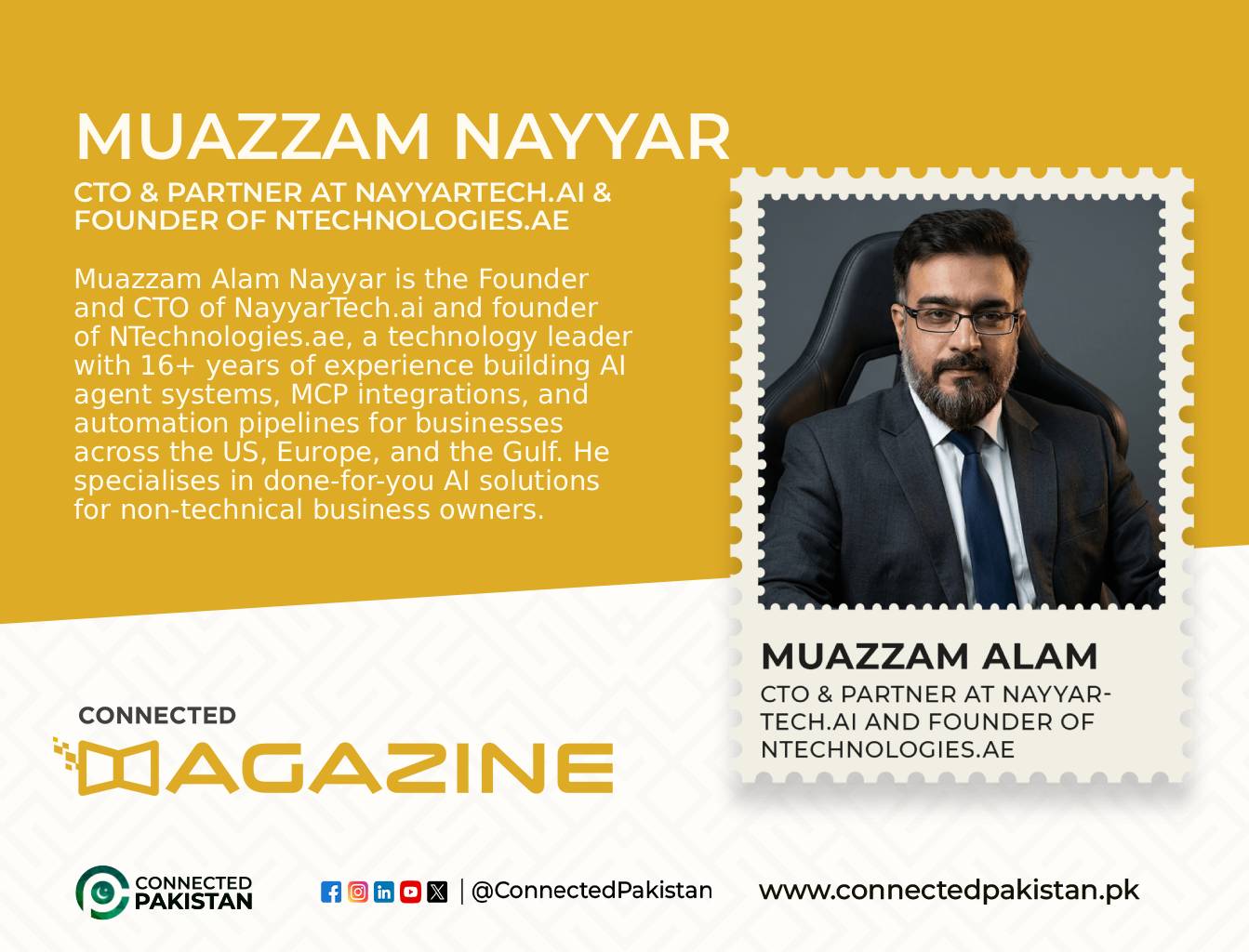
Muazzam Alam Nayyar is a Lahore-based technologist, CTO of US company Be Wise since 2017, and founder of NayyarTech.ai. He built his second act around AI implementation, helping non-technical businesses actually use AI (via automation and custom agents) rather than competing with free AI platforms, an approach summed up in his motto: "Shortcut Nahi, System Hai."
In an industry known for job-hopping and chasing the newest trend, Muazzam Alam Nayyar has done something unusual: he's spent nearly a decade deepening a single core technology relationship while steadily building new ventures around it. A Lahore-based technologist, he serves as CTO for a US company and has founded multiple companies, carving out a reputation as one of the technologists making generative AI genuinely usable for businesses that don't have engineering teams of their own.
His story is both an entrepreneurial journey and a lesson in strategic positioning, in reading where technology is headed and building the thing that makes it usable for everyone else. Here's his path, the genuinely smart insight behind his AI practice, and what founders and technologists can learn from it. (Note: his core roles are confirmed through his professional profiles; specific metrics and achievements reflect his own account of his work.)
Every strong second act rests on a solid foundation, and Nayyar's is a long track record of delivery. His rise from developer to Chief Technology Officer was earned running real teams under real pressure, not acquired in theory.
By his account, he scaled an engineering organization to 50-plus staff, running multiple enterprise projects in parallel, sustained very high system uptime across client environments over years (not just a single good quarter), and lifted delivery velocity significantly after leading a full transition from Waterfall to Agile Scrum. He reports delivering for major international clients and building a deep technical foundation across the major web stacks (MEAN, MERN, LAMP, and cloud-native architectures), giving him fluency across nearly every production web technology in use today. What's independently clear is his longevity and seniority: he has served as CTO for the US company Be Wise since 2017, and as a director of his own technology companies for over a decade. That kind of sustained, senior delivery, the unglamorous work of consistently shipping and keeping systems running, is the real foundation beneath everything that followed. It's a reminder that credible innovation usually stands on a track record of dependable execution.
Nayyar didn't stop at being a strong CTO for others, he built his own. By 2020, his track record had grown into something bigger than a single client engagement: he founded NayyarTech.ai, his own product-development company, with his long-running client relationship as its flagship account and proof of concept.
This is a pattern worth noting: rather than leaving one thing to start another, he layered new ventures on top of proven ones. NayyarTech.ai (confirmed as a Lahore-based AI and product-development company he founded) became the vehicle for his broader ambitions, harnessing AI to build solutions and products for businesses. Over time, he added more, an active pipeline of his own SaaS products and a Gulf-facing AI practice, while keeping his existing relationships running. This "build the next thing while the current thing is still earning" approach reflects a disciplined, compounding way of growing, rather than the risky "burn it down and start over" model. For founders, it's an instructive strategy: credibility and cash flow from proven work can fund and de-risk new ventures.
Here's the part of Nayyar's story with the most valuable lesson, and it's genuinely instructive. When generative AI moved from research labs into boardrooms around 2023, he made a deliberate, shrewd strategic decision that defined his second act.
The insight: rather than compete with the flood of free, well-funded AI platforms entering the market (a losing battle for most), he positioned himself one layer closer to the client, doing the implementation, customization, and hand-holding that off-the-shelf AI tools don't provide. Think about how smart this is. Everyone was rushing to build AI tools; Nayyar recognized that the real, underserved need wasn't another tool, but help actually using these tools, especially for non-technical business owners who don't know where to start. So he built an AI practice (including a Gulf-facing venture) specifically around that gap: taking powerful but confusing AI capabilities and making them genuinely work for ordinary businesses, through custom automation pipelines and AI agent systems. By his account, this delivers measurable results, up to 40% reductions in client operating costs through custom automation, and uses newer standards like the Model Context Protocol (MCP) for agent systems, adopted early. The lesson for anyone in tech: in a gold rush, selling tools is crowded, but helping people actually use the tools can be where the real, defensible value lies. That's strategic positioning done right.
Beyond his client and agency work, Nayyar maintains an active pipeline of his own products, reflecting a restless builder's instinct. By his account, these include tools aimed at specific niches and a lineup of SaaS products built on a shared modern stack.
His stated product portfolio spans things like a Google Business Profile audit tool for local-service businesses, an AI agent platform helping website owners resolve routine issues without a developer, a multi-product SaaS lineup (covering areas like lead generation, document/contract analysis, customer retention, reviews, and SOPs), and a QA/reliability layer for AI agents he's reportedly exploring as a standalone venture. What's notable isn't any single product, but the pattern: continuously building new things on a consistent technical foundation, while existing ventures keep running. It reflects a prolific, systematic approach to product development, spotting specific business problems and building focused tools to solve them. Whether every product succeeds or not (as with any builder's pipeline, some will and some won't), the disciplined, continuous-building mindset is itself instructive, and characteristic of genuine entrepreneurs who treat building as an ongoing practice, not a one-time bet.
Nayyar's interest in AI isn't limited to enterprise clients, he's also invested in sharing knowledge with Pakistan's broader community, which gives his story a generous dimension. By his account, he co-founded EmpowerX, a Roman-Urdu-language institute built to teach Pakistani creators how to monetize their audiences, extending technical guidance to a market that rarely gets access to it.
This community focus matters. By teaching in Roman Urdu and aiming at creators who typically lack access to high-level technical guidance, he's trying to democratize knowledge that's usually locked within elite tech circles. He's also reportedly active in AI-produced content himself, giving him firsthand insight into how AI is reshaping content economics from the creator side, not just the enterprise side. This dual perspective, serving enterprise clients while also empowering ordinary creators, reflects a genuine desire to share opportunity more widely. For Pakistan, where access to practical, high-level tech and AI education is often limited, people who break down enterprise-grade knowledge for ordinary learners provide real value. It's a reminder that expertise becomes most powerful when it's shared.
Running through Nayyar's work is a philosophy worth highlighting, because it's a refreshing contrast to much of the AI hype. His personal motto, which he uses as both a tagline and a working principle, is "Shortcut Nahi, System Hai", no shortcuts, only systems.
This is a deliberate rejection of the get-rich-quick noise surrounding AI and automation. In a space full of "make millions overnight with AI" promises, his emphasis on building real, lasting systems (rather than one-off hacks) stands out as genuinely sound. It shows up in how he reportedly teaches and works: drawing on real automation case studies from live client work rather than theoretical demos, focusing on long-term income systems over quick hacks, and being willing to break down complex, enterprise-grade AI concepts for people with no technical background. This systems-over-shortcuts mindset is exactly the right approach to technology and business, durable value comes from building solid systems, not chasing hacks. It's a philosophy as applicable to any professional or entrepreneur as it is to AI, and a healthy antidote to the hype. Substance over shortcuts, built to last.
Nayyar's journey reflects several positive dynamics in Pakistan's tech ecosystem.
For technologists and founders, he models a smart path: sustained delivery, building your own ventures on proven foundations, and reading technology shifts to find underserved niches (like AI implementation).
For AI adoption in Pakistan, his focus on making AI usable for non-technical businesses helps bridge the gap between AI's potential and real-world adoption, exactly what's needed for AI to deliver value across the economy.
For the ecosystem's global standing, a Lahore-based technologist running a Gulf-facing AI practice and serving international clients showcases Pakistani talent competing globally.
For knowledge-sharing, his efforts to teach creators and non-technical people (in Roman Urdu) help democratize access to valuable tech and AI skills, strengthening the broader community.
The most valuable, transferable lesson from Muazzam Alam Nayyar's story is strategic: in any technology shift, the biggest opportunity often isn't in the obvious, crowded place, but in the underserved gap that others overlook. When generative AI arrived, the obvious move was to build AI tools, and the market flooded with them. Nayyar's smarter move was to spot what was missing: the implementation, customization, and guidance that would let ordinary, non-technical businesses actually use AI. By positioning "one layer closer to the client," he found defensible, valuable territory while others fought over crowded ground. That's a masterclass in strategic positioning, and a lesson applicable far beyond AI.
The broader wisdom from his career is threefold. First, build on a foundation of genuine delivery, his credibility rests on years of consistently shipping and keeping systems running, the unglamorous work that earns trust. Second, layer and compound, grow by building new ventures on proven ones rather than risky all-or-nothing pivots. Third, embrace "systems, not shortcuts", durable success comes from building solid systems, not chasing hacks or hype, a principle as true in AI as anywhere. For Pakistan's technologists and founders, Nayyar's journey offers an inspiring and practical template: develop real expertise, deliver dependably, read where technology is going, find the underserved gap, and build the thing that makes the future usable for everyone else, all while sharing knowledge generously along the way. In a noisy, hype-filled tech landscape, that grounded, systematic, opportunity-spotting approach is exactly what builds lasting value, and lasting careers.
Given his pattern of continuous building and early reading of technology shifts, Nayyar seems likely to keep expanding his AI practice and product pipeline, and to keep finding new underserved gaps as AI evolves (particularly around AI agents and automation, areas he's already focused on). His dual focus, serving clients while empowering creators, suggests continued contribution to both enterprise AI adoption and broader knowledge-sharing in Pakistan.
More broadly, his story reflects a maturing Pakistani tech ecosystem where seasoned technologists are building globally-relevant AI practices and products from cities like Lahore. As AI adoption deepens across businesses, technologists who can bridge the gap between AI's potential and practical implementation, exactly Nayyar's niche, will be increasingly valuable. His trajectory is one to watch, both as an individual builder and as an example of the globally-competitive, systematically-built tech entrepreneurship Pakistan increasingly produces.
Muazzam Alam Nayyar's story is a compelling example of strategic, systematic tech entrepreneurship from Pakistan. From a long foundation of dependable delivery as a CTO, he built his own companies, and when generative AI arrived, he made a genuinely smart move: rather than competing with free AI tools, he positioned himself to do what those tools can't, helping non-technical businesses actually implement and use AI. That insight, finding the underserved gap others overlook, is the heart of his second act, and a valuable lesson for anyone in tech. Combined with his disciplined "layer new ventures on proven ones" growth, his prolific product-building, his generous knowledge-sharing with Pakistani creators, and his grounded "Shortcut Nahi, System Hai" philosophy, his career reflects exactly the kind of substance-over-hype, opportunity-spotting approach that builds lasting value. For Pakistan's technologists and founders, his journey is both inspiring and instructive: build real expertise, deliver consistently, read where technology is headed, find the gap, and build the thing that makes it usable for everyone else. Muazzam Alam Nayyar is still building, one system at a time, and his trajectory shows what thoughtful, globally-competitive tech entrepreneurship from Pakistan can look like.
This article profiles Muazzam Alam Nayyar based on available information, including his professional profiles (where his core roles, such as CTO of Be Wise and founder of NayyarTech.ai, and credentials like IBM Generative AI certification are listed) and his own shared account of his work. Specific metrics, client details, products, and achievements reflect his own stated account and may not be independently verified; individual results vary. This is a profile, not an endorsement, and not business or financial advice.
Muazzam Alam Nayyar is a Lahore-based Pakistani technologist and AI entrepreneur. His core roles are confirmed via professional profiles: Chief Technology Officer of US company Be Wise, LLC (since April 2017), founder of NayyarTech.ai (a Lahore-based AI and product-development company), and director of his own technology companies for over a decade. He is IBM Certified in Generative AI (RAG and LangChain) and has participated as a VC at GITEX Dubai. He holds a Computer Science degree from the University of the Punjab.
Career foundation (by his account): he rose from developer to CTO, scaling an engineering organization to 50+ staff running multiple enterprise projects, sustaining high system uptime over years, lifting delivery velocity ~25% via a Waterfall-to-Agile Scrum transition, and delivering for major international clients. He has deep full-stack expertise (MEAN, MERN, LAMP, cloud-native).
His key strategic insight: when generative AI moved into boardrooms around 2023, rather than compete with the flood of free, VC-funded AI platforms, he positioned himself "one layer closer to the client", doing the implementation, customization, and hand-holding that off-the-shelf AI tools don't provide, specifically for non-technical business owners. By his account, this delivers up to 40% reductions in client operating costs via custom n8n automation pipelines, and uses newer standards like the Model Context Protocol (MCP) for AI agent systems. He built a Gulf-facing AI practice (NTechnologies.ae) layered on top of his existing ventures, not replacing them.