According to the OICCI Digital Report, Pakistan’s digital economy could contribute 5 to 7% of GDP by 2030, but only if the country improves skill-based literacy, maintains consistent national policies, and builds a strong regulatory framework. Current strengths include $3.8 billion in IT exports and over 200 million telecom connections, held back mainly by weak fibre infrastructure. (54 words)
Let’s start with the headline. The OICCI, which represents major foreign investors in Pakistan, released a digital report laying out recommendations for the country’s digital future. Its projection: the digital sector could add 5 to 7% to GDP by 2030.
To understand whether that is realistic, look at where Pakistan stands today. The report highlights genuine strengths. IT and IT-enabled services exports stand at around $3.8 billion. Freelance earnings reached roughly $779 million. There are over 200 million telecom connections and more than 150 million broadband subscriptions. The mobile ecosystem alone is estimated to contribute about $17 billion to the economy. The Raast instant payment system processed trillions of rupees in transactions.
These are not small achievements. They show a digital economy that is already real and growing. The question is whether it can grow fast and deep enough to hit that 5 to 7% mark. And that depends on fixing some clear weaknesses.
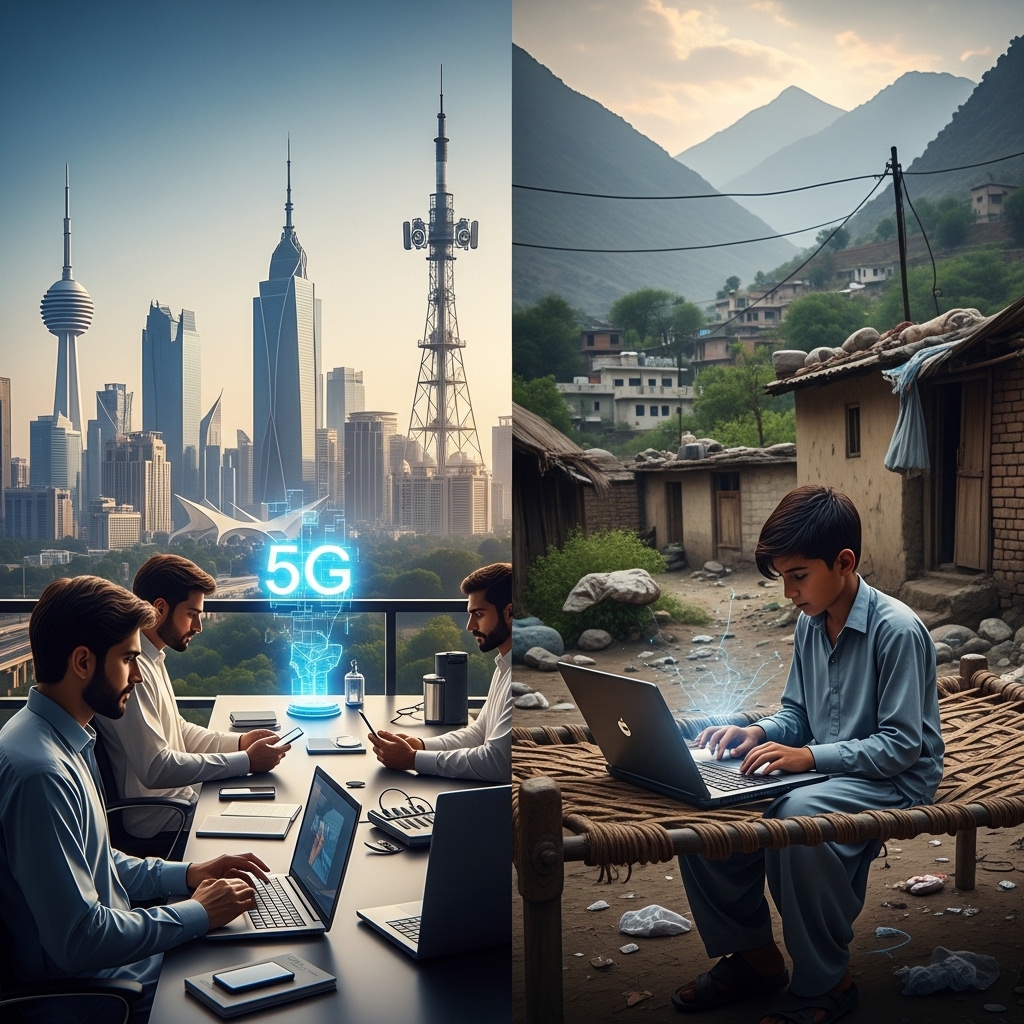
The single most striking weakness in the report is physical. Only about 18% of Pakistan’s cellular towers are connected by fibre. The global benchmark is around 40%.
This matters more than it might sound. Fibre-connected towers are what deliver fast, reliable mobile internet and make next-generation technologies like 5G work properly. Without fibre in the ground, the whole system is capacity-limited, no matter how many users sign up or how many phones are sold.
So the first condition for reaching 7% of GDP is a serious acceleration of fibre deployment. A digital economy runs on infrastructure, and right now Pakistan’s foundation is thinner than it should be. Encouragingly, there has been movement here, including measures to allow easier fibre laying on government land, but the gap to the global benchmark is still wide.
The second condition is less visible but just as important: consistent, clear policy.
The OICCI report points to regulatory delays and uncertainty as a drag on the sector. When rules keep changing, or when approvals take too long, investors hesitate and companies cannot plan. The report specifically calls for clearer digital regulations and lower taxes on broadband and devices, which are among the highest in the region.
High taxes on internet and smartphones are a particular problem for a country trying to get more people online. If connectivity is expensive, adoption slows, and a digital economy cannot grow if people cannot afford to participate in it. Consistent, supportive policy is the difference between a sector that attracts investment and one that scares it away.
The third condition is people. The 5 to 7% projection is explicitly tied to skill-based literacy. In plain terms, Pakistan needs far more people with real digital skills.
This connects to the country’s wider push to train youth in AI and technology. A digital economy is only as strong as the workforce that powers it. The IT companies, the freelancers, the startups, all of them need a steady supply of skilled talent. Without it, growth hits a ceiling no matter how good the infrastructure or policy is.
This is also where Pakistan has historically lagged. Broader regional comparisons have shown Pakistan behind peers on measures like university enrollment and technology readiness. Closing that gap is not optional for the 2030 target. It is central to it.
For Pakistan’s economy, the stakes are enormous. Moving the digital sector from its current level to 5 to 7% of GDP would mean a major new engine of growth, jobs, and foreign earnings, in a country that badly needs all three. The digital economy is one of the few areas where Pakistan can compete globally without heavy physical exports.
For businesses and startups, it means a bigger, better-connected market and a deeper talent pool. For freelancers and remote workers, it means stronger infrastructure and, hopefully, friendlier policy. For young people, it means the skills they build now are pointed at the fastest-growing part of the economy.
For the country’s global position, it matters because the alternative is falling further behind. Regional peers are growing their digital economies quickly. Standing still is not neutral. It means losing ground.
The most honest thing to say about the 7% target is this: the projection is not the hard part. The follow-through is.
The report itself contains the warning. Of the recommendations made in its 2022 edition, only about a quarter have been implemented. That single fact tells you where the risk lies. Pakistan does not usually lack good plans or accurate diagnoses. It lacks consistent execution over time.
So the 5 to 7% figure is best understood not as a prediction, but as a test. If Pakistan accelerates fibre, steadies its policy, and closes the skills gap, the target is reachable. If it keeps producing reports whose recommendations sit unimplemented, the number will stay a projection. The potential is genuinely there. Whether it is realized depends on whether the country can do the unglamorous work of execution, year after year.
Watch the infrastructure numbers most closely. If the share of fibre-connected towers starts climbing toward the global benchmark, that is the clearest sign the foundation is being built. Watch also for policy stability: fewer sudden tax changes and faster approvals would signal a friendlier environment. And watch the skills pipeline, since the AI and digital training programs now launching will determine whether there are enough people to power the growth.
If these move together over the next few years, Pakistan’s digital economy could genuinely approach the OICCI projection by 2030. If they stall, the country will likely keep posting good individual numbers, record exports here, a new data center there, while the overall share of GDP grows more slowly than it could. The difference is entirely within Pakistan’s control.
Pakistan’s digital economy reaching 5 to 7% of GDP by 2030 is a real and worthwhile possibility, backed by genuine current strengths. But the OICCI projection is a conditional one, and the conditions are clear: build the fibre infrastructure, keep policy consistent and affordable, and close the skills gap.
None of those are mysteries. They are known problems with known solutions. The target, in the end, is less about potential and more about discipline, the discipline to implement what the country already knows it needs to do. Pakistan has the talent and the momentum. The next few years will show whether it has the follow-through to turn a promising projection into a delivered result.
This article is for general information only and is not investment or policy advice. Projections and figures are based on reported data and may change.
The OICCI (Overseas Investors Chamber of Commerce and Industry) Digital Report projects that Pakistan’s digital economy could contribute 5 to 7% of GDP by 2030, but the projection is conditional on three things: improved skill-based literacy, consistent national policies, and a strong regulatory framework. Pakistan’s current strengths are real: around $3.8 billion in IT and IT-enabled services exports, roughly $779 million in freelance earnings, over 200 million telecom connections, more than 150 million broadband subscriptions, and a mobile ecosystem contributing an estimated $17 billion. The main weakness is infrastructure, with only about 18% of cellular towers fibre-connected versus a global benchmark of around 40%, which limits capacity for next-generation technologies like 5G. Other barriers include regulatory delays, high taxes on broadband and devices, and a digital skills gap. The report’s most telling point is on execution: only about a quarter of its 2022 recommendations were implemented, meaning the central risk is weak follow-through rather than a lack of potential. For Pakistan, reaching the target would create a major new engine of growth, jobs, and foreign earnings, while standing still means falling behind faster-growing regional peers. The honest conclusion: the 5 to 7% figure is a test of discipline and execution, not a prediction. The potential is genuine; realizing it depends on building fibre infrastructure, steadying policy, and closing the skills gap over the next several years. This is general information, not investment or policy advice.