PMOS (Prime Minister's Office System) is Pakistan's first AI-powered government platform, launched on July 21, 2026. It records, communicates, monitors, and tracks every directive issued by the Prime Minister, from issuance through implementation, verified completion, and post-completion review, replacing paper-based workflows with digital processes across ministries.
Pakistan's government just made an unusually bold move into artificial intelligence, and this time it is aimed squarely at itself. Prime Minister Shehbaz Sharif has launched an AI-powered system that will record and track every single directive he issues, following each one from the moment it is given until it is verified as complete.
It comes with a striking declaration: no more paper files. This is one of the most concrete examples yet of Pakistan applying AI to its own governance problems. Here is what the system actually does, why it matters, and an honest look at whether it can deliver on the promise.
The system has a straightforward name and an ambitious mission. Prime Minister Shehbaz Sharif launched the Artificial Intelligence-based Prime Minister's Office System (PMOS), describing it as a transformative digital platform that will modernise governance by recording, communicating, monitoring, and tracking every directive he issues.
The tracking is comprehensive, covering the full lifecycle of a decision. The system follows each directive from issuance through implementation, verified completion, and post-completion monitoring. In other words, it does not just log an order, it follows it all the way through, and then checks whether it actually worked.
The PM was direct about what this means for how the government operates. He told officials that traditional paper-based working would be replaced by digital processes, saying that from now on he would not expect anyone to come to him with a file in their hands, and that everything would be discussed through the new mechanism.
This is a fair question, since "AI" gets attached to a lot of ordinary software. According to the officials who briefed the launch, there is a genuine distinction here.
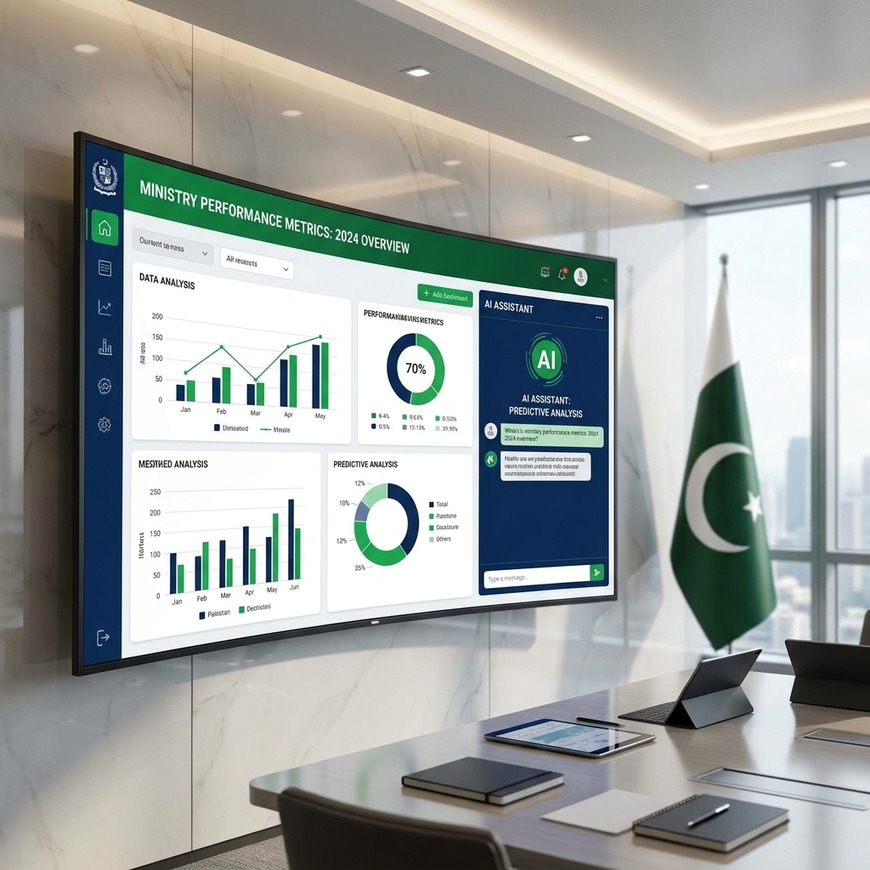
Unlike conventional government tracking systems, PMOS uses artificial intelligence to read, classify, and analyze directives rather than simply storing them. That is the meaningful difference: a normal database holds records, while this system is designed to actually process and understand what it holds.
It also functions as a decision-support tool. The platform combines analytics with structured government information in a protected IT environment, and at its core is a digital repository recording every directive along with its complete implementation trail, creating a permanent institutional record of government decisions.
Officials described it as Pakistan's first government platform to integrate artificial intelligence as a core component of decision-making and implementation monitoring, positioning it as a landmark in the country's digital transformation.
To appreciate why this matters, consider the problem it targets. In many governments, including Pakistan's, decisions get made at the top and then disappear into a bureaucratic maze. Orders are issued, files move slowly between departments, follow-up is inconsistent, and often nobody can say with certainty whether something was actually done.
PMOS is essentially an accountability machine aimed at that gap. By creating a permanent, searchable, AI-analyzed record of every directive and its progress, it makes it far harder for decisions to quietly vanish. The system tracks implementation against defined timelines and quality standards, which introduces measurable accountability where there often was none.
The stated wider goal is better governance overall. Officials said the platform will support continuous policy calibration, helping the government use technological, financial, and human resources more effectively to improve economic outcomes.
The implications reach beyond the PM's office.
For citizens, better follow-through on government decisions could eventually mean faster, more reliable public services. If directives about hospitals, schools, or infrastructure are actually tracked to completion, people feel the difference.
For the civil service, it represents a significant cultural shift, from paper files and informal follow-up to digital workflows with visible timelines and accountability. That is a big adjustment, and how well officials adapt will shape the outcome.
For Pakistan's tech sector, it is a strong signal. A government using AI at its own core creates demand for local digital talent, systems, and infrastructure, and lends credibility to Pakistan's broader AI ambitions, including its billion-dollar AI plan.
For the country's digital reputation, being early among developing nations to embed AI in central governance is genuinely notable, if it works in practice.
Here is where honesty matters. The technology is the easy part. The hard part, in any country, is people and process.
A system like PMOS only delivers value if three things happen. Officials must actually use it rather than working around it. The data entered must be honest, since a tracking system fed with optimistic or inaccurate updates simply automates the appearance of progress rather than progress itself. And leadership must consistently act on what the data reveals, including when it shows failure.
The PM's insistence on immediate, full adoption, and his personal refusal to accept paper files, is a meaningful signal, since top-level commitment is usually what determines whether such systems succeed or quietly fade. But Pakistan, like many countries, has a history of ambitious digital initiatives that launched well and then lost momentum. The relevant question is not whether the platform works technically, but whether it changes behavior over the coming years.
There is also a reasonable question about transparency. A permanent record of government decisions is powerful. Whether any of that visibility eventually extends to the public, or remains purely internal, will shape how much it strengthens accountability in the fuller sense.
Watch for practical signals over the coming months: whether ministries genuinely shift to the platform, whether completion data is published or referenced publicly, whether the system expands to provincial governments, and whether officials report it improving, rather than merely documenting, their work.
If PMOS succeeds, it could become a template for digitizing other layers of Pakistani government, and a genuine case study for other developing nations. If it stalls, it joins a long list of well-intentioned launches. The next year will tell.
The launch of PMOS is a genuinely interesting step: Pakistan applying AI not to flashy consumer products, but to the unglamorous, essential problem of making government follow through on its own decisions. The concept is sound, the technology appears substantive, and the leadership commitment, symbolized by banishing paper files, is real. The open question, as always, is execution and honest use. If it works, citizens may eventually notice something rare and valuable: a government that actually finishes what it starts. That would be a digital transformation worth celebrating.
This article is for general informational purposes only and reflects official announcements and reports from July 2026. The system's effectiveness will depend on implementation over time; this is not a government endorsement or evaluation.
On July 21, 2026, Pakistan's Prime Minister Shehbaz Sharif launched the AI-based Prime Minister's Office System (PMOS), described by officials as Pakistan's first government platform to integrate artificial intelligence as a core component of decision-making and implementation monitoring.
PMOS records, communicates, monitors, and tracks every directive issued by the Prime Minister across its full lifecycle: issuance, communication to ministries, implementation against defined timelines and quality standards, verified completion, and post-completion review. At its core is a digital repository storing every directive with its complete implementation trail, creating a permanent institutional record of government decisions. Unlike conventional tracking systems, it uses AI to read, classify, and analyze directives rather than merely storing them, and functions as a secure decision-support system combining analytics with structured government information.
At the launch, PM Shehbaz directed all ministries and departments to adopt the system immediately, stating that paper-based working would be replaced by digital processes: "From today onwards, I will not expect any of you with a file in your hands. Everything will be discussed through this mechanism." He credited IT Minister Shaza Fatima Khawaja and the IT Secretary with developing and operationalizing it. Officials said the platform will support continuous policy calibration, helping government use technological, financial, and human resources more effectively for better economic outcomes.
Analysis: the technology addresses a real governance gap (directives disappearing into bureaucracy without follow-through), but success depends on officials genuinely using it, honest data entry, and leadership acting on findings, not on the technology itself. It fits Pakistan's broader digital transformation and AI agenda.
This is informational, not an endorsement or evaluation of the system.