Pakistan has assigned E-Band spectrum to mobile operators to provide high-capacity wireless backhaul for 5G. The move addresses a key bottleneck: only about 17.9% of Pakistan's mobile towers are connected by fiber. Operators must reach 20% fiber-to-the-site by 2028, rising to 35% by 2035, under their 5G licence conditions.
If you have been wondering why Pakistan's newly launched 5G still does not feel fast, the government just released data that explains a big part of the answer. And it has taken a concrete step to address it.
Pakistan has assigned new E-Band spectrum to mobile operators to boost 5G capacity. But buried in the announcement is a revealing statistic: fewer than one in five of Pakistan's mobile towers are connected by fiber. That single number explains a lot about the country's internet quality. Here is what the new spectrum does, what fiberization means for your connection, and whether things will actually improve.
The move is a practical, technical one aimed at expanding 5G capacity quickly. The Government of Pakistan has assigned E-Band spectrum to Cellular Mobile Operators (CMOs) to support high-capacity wireless backhaul following the recent launch of 5G services.
This follows the major spectrum sale earlier this year. The move follows the PTA's auction of 480 MHz of spectrum in March for next-generation mobile services. According to the PTA, the E-Band assignment is intended to support the deployment and expansion of 5G networks.
There is good news on cost, too. Officials clarified that no additional spectrum charges are being imposed for the E-Band assignment, meaning operators get this capacity boost without a new fee, removing one barrier to faster rollout.
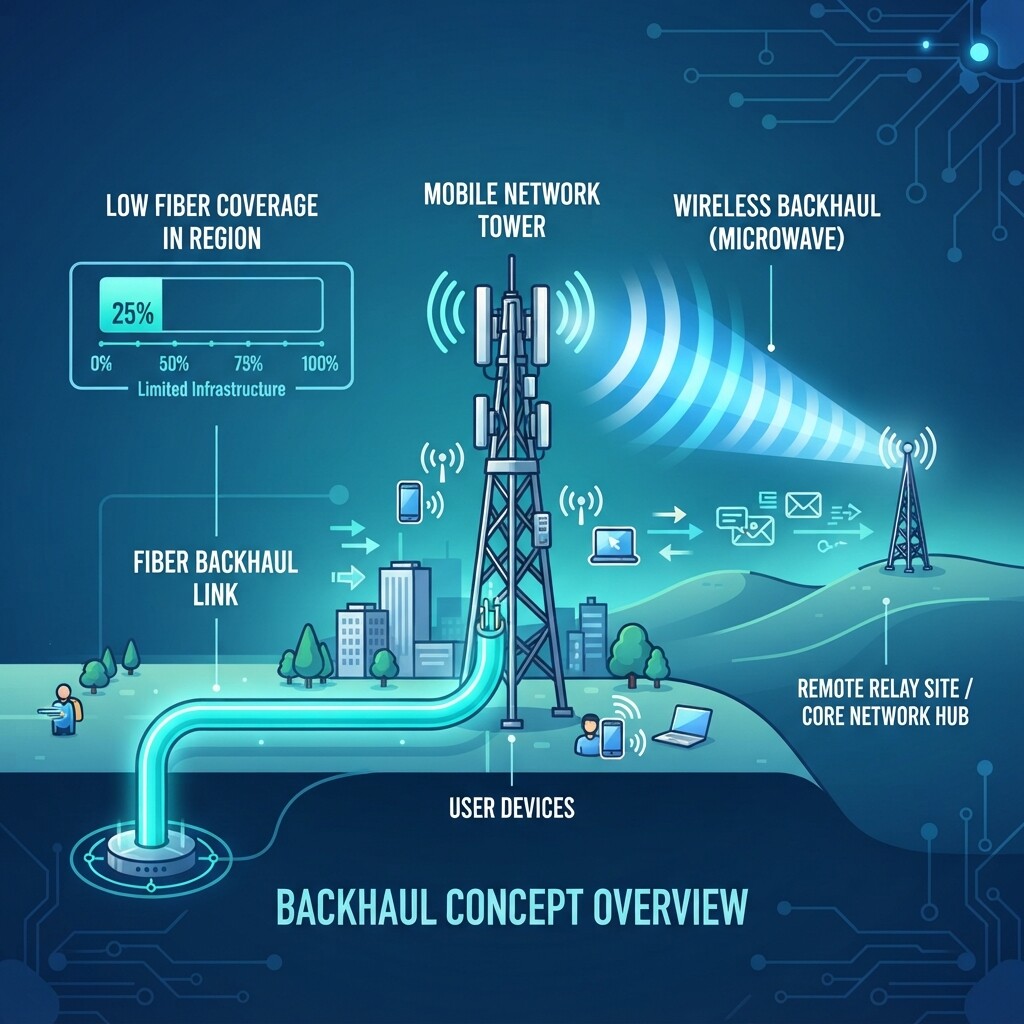
To understand why this matters, you need to know one simple concept. Every mobile tower needs a connection back to the core network, that link is called "backhaul." Think of the tower as a local post office: it collects and delivers data in your area, but it needs a highway to move that data to and from the rest of the network.
If that highway is narrow, it does not matter how modern the tower is. Your 5G phone might connect at high speed to the tower, but if the tower's connection to the network is weak, your actual internet stays slow. This is exactly the bottleneck Pakistan is facing.
The best backhaul is fiber optic cable, which carries enormous amounts of data reliably. The alternative is wireless backhaul, using radio links, which is what E-Band provides.
Here is the number that tells the story. According to a PTA document, the current tower fiberization level across Pakistan's mobile sector is approximately 17.9 percent.
That means over 80% of Pakistan's mobile towers are not connected by fiber. For a country trying to deliver 5G, this is a serious structural weakness, and it explains why users in 5G-enabled cities often see little improvement.
The operator-by-operator breakdown is revealing. Jazz has the highest fiberization level at 22 percent, followed by Zong (CMPak) at 19 percent, Telenor at 16 percent, and Ufone at just 9 percent. That last figure is striking given that Ufone, now merged with Telenor, is one of the country's largest operators.
Regulators have set binding targets, which is encouraging. Under the NGMS/5G licence conditions, all operators are required to achieve a minimum Fiber-to-the-Site (FTTS) ratio of 20 percent during Phase-I (2026-28), rising gradually to 35 percent by Phase-IV (2032-35).
Two honest observations here. First, it is good that enforceable targets exist, they create accountability. Second, the targets are modest and long-term: reaching just 35% fiberized towers by 2035 means the majority of Pakistani towers will still lack fiber a decade from now. As one reader commented on the news, seeing Ufone at 9% today with a 35% target for 2035 is not exactly reassuring.
The PTA is clear on why it matters, stating that increasing fiberization will help meet the backhaul capacity requirements of 5G services.
This is where the new spectrum comes in as a practical workaround. Laying fiber is expensive, slow, and complicated, it requires digging, permissions, and right-of-way access across cities and rural areas.
E-Band offers a faster alternative. PTA officials said operators can use E-Band spectrum in areas where fiber connectivity is unavailable, explaining that it provides high-capacity wireless links capable of carrying the large amounts of data generated by 5G networks. Operators will procure equipment to use it, allowing them to rapidly expand network capacity without laying fiber in every location.
Sensibly, the approach is flexible: each operator will decide where fiber is the better option and where E-Band wireless backhaul is more practical. The government is also facilitating Right of Way through policy measures to ease network rollout, addressing a known obstacle to laying fiber.
The honest caveat: wireless backhaul is a strong solution, but fiber remains the gold standard for capacity and reliability. E-Band is best understood as a smart accelerator, not a replacement for the fiber Pakistan ultimately needs.
This technical decision has real consequences for everyday users.
For mobile users, better backhaul should mean genuinely faster, more reliable data, especially in areas where fiber was never going to arrive soon. This is the infrastructure work that turns "5G available" into "5G that actually works."
For freelancers and remote workers, who depend on stable connections for income, improvements here directly affect earning ability. Pakistan's millions of online workers need reliable uploads and calls, not just signal bars.
For businesses and the digital economy, better connectivity underpins everything from e-commerce to cloud services to the country's AI ambitions. As we have covered before, Pakistan's digital goals rest on connectivity foundations that are still being built.
For operators, it lowers the cost and complexity of expanding 5G, which should speed up deployment, provided they actually invest.
This story reinforces a theme running through Pakistan's tech landscape: the gap between announcements and infrastructure. Launching 5G is the easy, headline-friendly part. Building the unglamorous backbone, fiber, backhaul, reliable power, is the hard part that actually determines user experience.
The E-Band assignment is a genuinely sensible, practical step. It gives operators a faster path to capacity without waiting years for fiber. Combined with binding fiberization targets and Right of Way support, the policy direction is sound.
But policy is not delivery. The real test is whether operators invest in the equipment and rollout, and whether users notice a difference in the coming months. Pakistan's telecom sector has thin margins and faces high costs, so execution is far from guaranteed.
Expect gradual improvement rather than a sudden leap. As operators deploy E-Band links and slowly expand fiber toward their 20% Phase-I target, capacity should improve, particularly in dense urban areas where demand is highest.
The bigger question is whether Pakistan can accelerate beyond these modest targets. A country serious about a digital economy will eventually need far more than 35% fiberized towers. Watch for operator investment announcements, actual speed improvements in your area, and whether the government pushes for more ambitious infrastructure goals.
Pakistan's E-Band spectrum assignment is a smart, practical move to strengthen 5G where fiber is missing, and the fact that it comes at no extra charge to operators makes it more likely to be used. But the more important revelation is the underlying data: with only 17.9% of towers fiberized, Pakistan's internet quality problem is fundamentally an infrastructure problem, not a spectrum one. The new spectrum helps, and the targets create accountability, but real, lasting improvement will require serious, sustained investment in the backbone. For users hoping for faster internet, this is genuine progress worth welcoming, just keep expectations grounded in the fiber numbers.
This article is for general informational purposes only and reflects PTA documents and reports available as of July 2026. Network performance varies by location and operator; rollout timelines can change.
On July 21, 2026, the Government of Pakistan assigned E-Band spectrum to Cellular Mobile Operators to provide high-capacity wireless backhaul supporting 5G deployment, following the PTA's March 2026 auction of 480 MHz for next-generation mobile services. No additional spectrum charges apply to the E-Band assignment.
The announcement revealed a key structural problem: Pakistan's tower fiberization is only about 17.9%, meaning over 80% of mobile towers lack fiber backhaul (the high-capacity link connecting towers to the core network). Without strong backhaul, 5G speeds cannot be delivered even where 5G is live. Operator breakdown: Jazz 22%, Zong (CMPak) 19%, Telenor 16%, and Ufone just 9%.
Under NGMS/5G licence conditions, all operators must achieve a minimum 20% Fiber-to-the-Site (FTTS) ratio in Phase-I (2026-28), rising to 35% by Phase-IV (2032-35), targets that are binding but modest, leaving most towers unfibered even a decade out.
E-Band serves as a practical workaround: operators can deploy high-capacity wireless links where fiber is unavailable, expanding capacity quickly without digging cable everywhere. Operators choose per location whether fiber or E-Band makes more sense. The government is also facilitating Right of Way through policy measures to ease rollout, and the Frequency Allocation Board continues approving microwave allocations.
Context: this follows reports that Pakistan's 5G, live across 449 tower sites in 22 cities, still delivers poor real-world speeds because it runs on existing infrastructure. Fiber remains the gold standard; E-Band is an accelerator, not a replacement.
This is informational; network performance varies by location and rollout timelines can change.