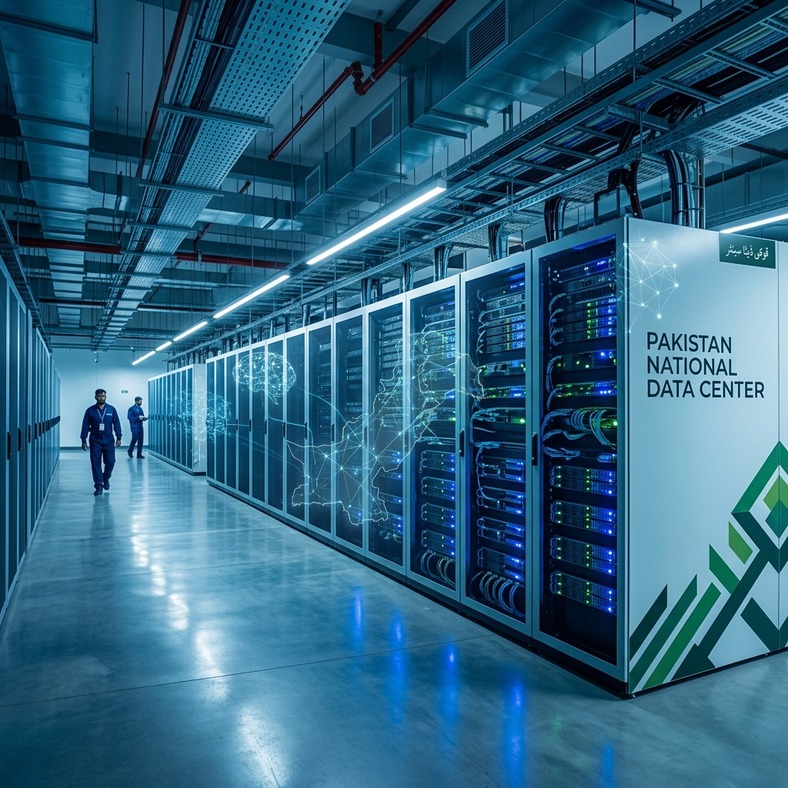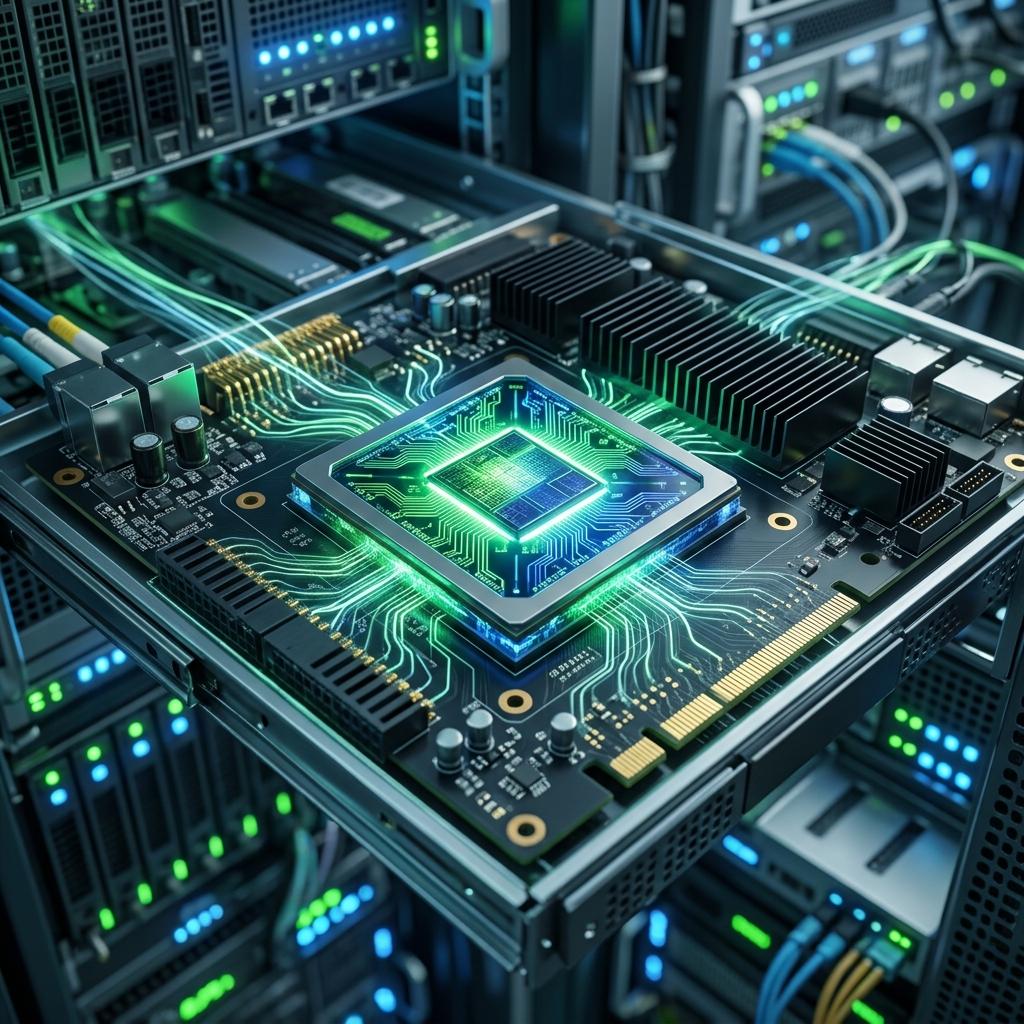
Indus Cloud (Master Group), with Cisco, launched Pakistan's first AI GPU cluster powered by NVIDIA H200 chips in August 2026, bringing brand-new H200 GPUs onto Pakistani soil for the first time. These high-end chips power AI training and large language models, giving local businesses, startups, and universities in-country access to world-class AI computing.
Just yesterday, we wrote about the global AI arms race, how the world's tech giants are spending hundreds of billions to secure scarce, high-end computing chips. Today, there's a genuinely exciting local development that connects directly to that story: some of those very chips have just arrived in Pakistan for the first time.
Pakistan has taken a concrete step from talking about AI to building the hardware foundation for it. A local company has brought in brand-new NVIDIA H200 GPUs, the powerful, hard-to-get chips at the heart of the AI revolution. Here's what actually happened, what these chips are, why getting them is a real achievement, and what it means for Pakistan's AI future.
The announcement marks a first for the country. Indus Cloud, part of Pakistan's Master Group, in partnership with US tech giant Cisco, launched Pakistan's first Cisco AI GPU Cluster powered by the latest NVIDIA H200 Tensor Core GPUs, making brand-new NVIDIA H200 GPUs available on Pakistani soil for the very first time.
The purpose is to give local organizations direct access to serious AI computing power. The cluster is designed to provide researchers, enterprises, startups, universities, and government organizations with access to world-class accelerated computing infrastructure, without the latency, compliance, and data-sovereignty challenges of relying solely on overseas cloud providers.
In the company's framing, this is foundational. Its CEO described it as more than new infrastructure, calling it a foundation for Pakistan's AI future that eliminates a major barrier for organizations seeking access to advanced AI compute. That's the crux of why this matters: it removes a genuine bottleneck.
To grasp the significance, you need to understand what these chips actually are. A GPU (graphics processing unit) is a specialized chip that's extremely good at the kind of massively parallel math that AI requires. NVIDIA's data-center GPUs are the undisputed engines of the modern AI boom, and the H200 is one of its high-end models.
The H200 is genuinely powerful. It offers 141GB of high-speed HBM3e memory and 4.8 TB/s of bandwidth, the kind of specifications needed to train and run large AI models. It's purpose-built for demanding AI workloads including large language models (LLMs), generative AI, AI training and fine-tuning, high-performance inference, computer vision, and advanced analytics. In short, it's exactly the hardware you need to do serious AI work.
These chips are also expensive and scarce: a single H200 costs roughly $30,000–$40,000 to buy, and global demand far outstrips supply. That scarcity is precisely why bringing them to Pakistan is notable.
Here's context that makes this more impressive than a typical product launch. As we covered in the global AI arms race, these high-end chips are the scarcest, most fought-over resource in technology right now, with even giant companies struggling to secure enough.
On top of that, Pakistan faces a specific hurdle: it sits on the US restricted list for advanced chip exports, meaning acquiring cutting-edge NVIDIA GPUs requires clearing strict technical, compliance, and financing checks under US export-control rules. Getting brand-new H200s legally into the country is therefore a genuine logistical and regulatory accomplishment, not a simple purchase. (Notably, another local player, Data Vault Pakistan, has reported securing 3,000+ GPUs through official NVIDIA-approved channels, showing this is becoming a real, competitive local industry.)
So this isn't just buying some computers. It's Pakistan clearing real barriers to bring in the exact hardware that powers frontier AI, a meaningful step for a country on the restricted list.
Beyond the technical achievement, there are two big practical reasons this matters. The first is data sovereignty and independence. Currently, Pakistani organizations doing AI work must often rely on foreign cloud providers, sending their data and computing abroad, which raises latency, compliance, and data-sovereignty concerns. Having powerful GPUs locally means sensitive data (government, financial, corporate) can stay inside Pakistan while still accessing world-class compute.
The second is economics. Pakistan currently spends an estimated $700–800 million a year on foreign cloud and computing services, according to industry figures. Every workload that runs on local infrastructure instead keeps some of that money, and the associated jobs and expertise, inside the country. Over time, that's a significant economic and strategic benefit.
Together, these make local AI compute not just a technical nicety but a matter of national digital independence.
Encouragingly, this isn't an isolated event, it's part of a genuine, accelerating local build-out. Pakistan is suddenly seeing real competition to build AI infrastructure.
Alongside Indus Cloud's H200 cluster, Data Vault Pakistan launched a sovereign AI cloud with Telenor and is being assessed by US giant Supermicro for even more advanced Blackwell-class chips. Gul Ahmed Energy Group's Quantum Global Data Centre announced a $230 million facility with Huawei. And as we've covered, Sky47's Karakoram-01 data centre recently launched too. Interestingly, Pakistan is developing parallel tracks, some US-aligned (NVIDIA/Cisco/Supermicro) and some China-aligned (Huawei), giving it multiple paths to compute.
This competition is genuinely good news. Multiple players racing to provide local AI infrastructure means faster progress, more access, and better options for Pakistani innovators. The ecosystem is forming in real time.
This development has real, practical implications across the board.
For startups and researchers, local access to H200-class compute means they can train and run serious AI models without the cost, latency, and complexity of foreign clouds, lowering a major barrier to building AI products in Pakistan.
For universities, access to world-class GPUs enables real AI research and training the next generation of engineers on current hardware.
For enterprises and government, it allows AI adoption while keeping sensitive data within national borders, important for banking, defense, and public services.
For the broader ecosystem, it signals Pakistan is serious about AI infrastructure, which attracts talent, investment, and further development. It's the kind of foundation that everything else builds on.
An honest assessment keeps this in perspective while giving real credit. This is a genuinely important, praiseworthy milestone, bringing scarce, cutting-edge AI chips into a country on the export-restricted list is a real achievement, and the focus on sovereign, locally-accessible compute is exactly right.
At the same time, perspective matters. A single GPU cluster, however powerful, is a starting point, not a transformation. The global giants operate hundreds of thousands of these chips; Pakistan is beginning to build capacity measured very differently. The true test will be adoption and expansion: whether Pakistani startups, researchers, and enterprises actually use this compute to build valuable things, whether more clusters follow, and whether reliable power and skilled talent keep pace. As with all of Pakistan's AI infrastructure moves, the hardware is necessary but not sufficient, using it well is the next challenge.
Viewed correctly, this is the right kind of step: concrete, foundational, and repeatable. Pakistan is laying tracks. Now it needs to run trains on them.
Expect this local infrastructure race to accelerate. Watch for more GPU clusters and data centers coming online, potentially even more advanced chips (like Blackwell-class, pending export approvals), and, most importantly, growing adoption by local startups and researchers. The key question is whether access to compute translates into actual Pakistani AI products, services, and research.
Combined with Pakistan's other AI moves, data centers, AI hubs, cloud programs, training initiatives, this H200 launch adds a crucial piece: the raw computing power. If the ecosystem keeps building and, crucially, using this capacity, Pakistan's AI ambitions become considerably more credible.
Pakistan getting its first brand-new NVIDIA H200 AI chips is a genuinely exciting and meaningful milestone. In a world where these exact chips are the scarcest, most valuable resource in technology, and for a country facing export restrictions, bringing them onto Pakistani soil is a real achievement. It gives local startups, researchers, universities, and institutions access to world-class AI compute, keeps data and money within the country, and adds a vital piece to Pakistan's growing AI infrastructure. It's not a finish line, one cluster doesn't rival the global giants, and the real test is whether Pakistan uses this power to build. But it's exactly the right kind of step: concrete, foundational, and full of promise. Pakistan just plugged in some of the world's most sought-after AI hardware. Now comes the exciting part, seeing what its innovators build with it.
This article is for general informational purposes only and reflects announcements from 2026. Technical specifications, prices, and details are as reported and may change. This is not investment advice or an endorsement of any company.
In August 2026, Indus Cloud (part of Pakistan's Master Group), in partnership with US tech giant Cisco, launched Pakistan's first Cisco AI GPU Cluster powered by NVIDIA H200 Tensor Core GPUs, bringing brand-new H200 chips onto Pakistani soil for the first time. The cluster gives researchers, enterprises, startups, universities, and government access to world-class AI compute locally, avoiding the latency, compliance, and data-sovereignty issues of foreign clouds.
The NVIDIA H200 is a high-end data-center GPU for AI workloads, offering 141GB HBM3e memory and 4.8 TB/s bandwidth, purpose-built for large language models, generative AI, training/fine-tuning, high-performance inference, computer vision, and analytics. Each costs roughly $30,000-$40,000 and they are globally scarce.
Getting them is a real achievement because these chips are the most fought-over resource in tech, and Pakistan sits on the US restricted list for advanced chip exports, requiring strict technical, compliance, and financing clearance. (Separately, Data Vault Pakistan reports securing 3,000+ GPUs through NVIDIA-approved channels.)
Why it matters: (1) data sovereignty, sensitive government/financial/corporate data can stay in-country; (2) economics, Pakistan spends an estimated $700-800 million/year on foreign cloud services, which local infrastructure can retain. It's part of an accelerating local build-out: Data Vault's sovereign cloud with Telenor (and Supermicro assessing Blackwell-class chips), Gul Ahmed's $230M Quantum Global data center with Huawei, and Sky47's Karakoram-01, giving Pakistan parallel US-aligned and China-aligned tracks.
Honest caveat: one cluster is a foundation, not a transformation, global giants run hundreds of thousands of such chips. The real test is adoption (whether local startups/researchers build with it), expansion, reliable power, and talent.
Informational only; specs/figures as reported; not investment advice.