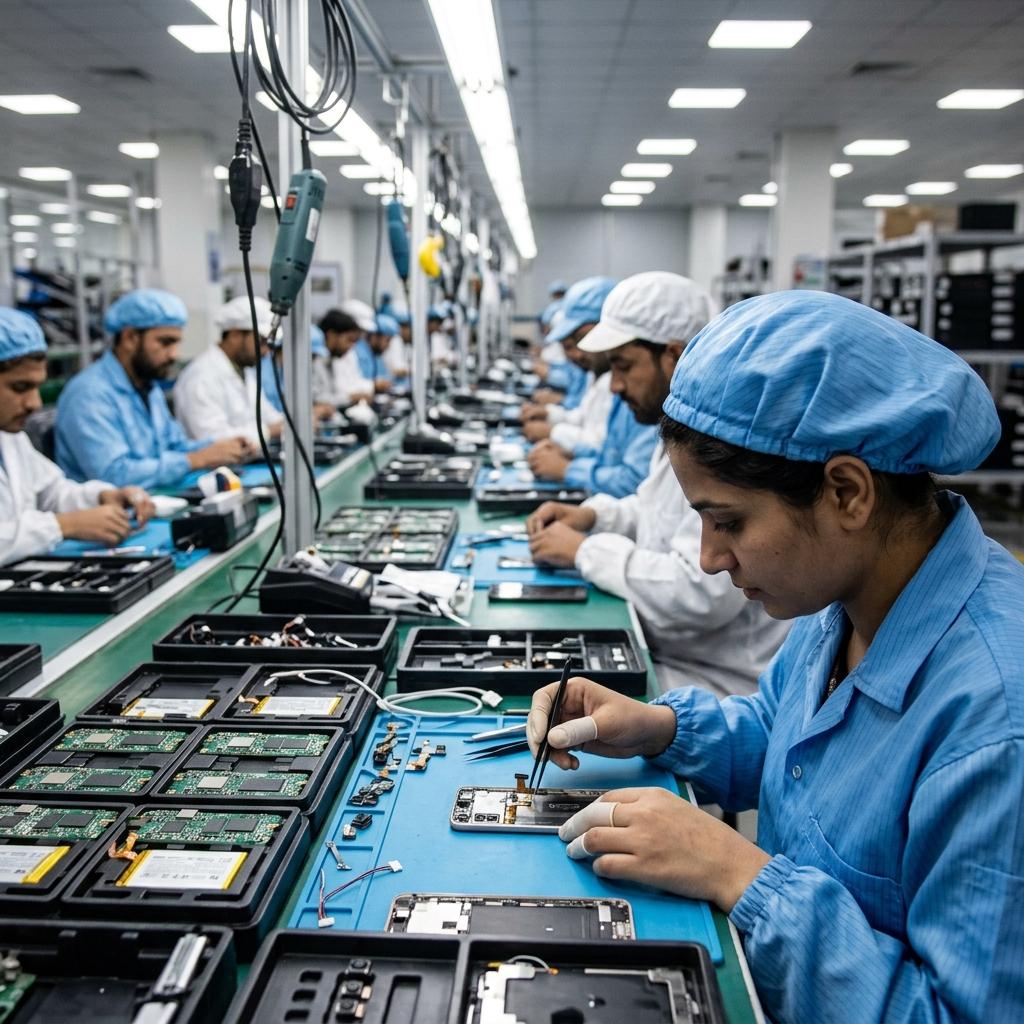
Pakistan now assembles almost all its own phones, 18.66 million locally in the first 8 months of 2026 versus just 2.74 million imported, a genuine manufacturing success driven by its Mobile Device Manufacturing Policy. But 5G-phone production is slipping and 5G adoption lags, largely because high taxes and duties keep smartphone prices (especially 5G models) out of reach for many.
Here's a genuine Pakistani success story that doesn't get enough attention: the country now makes almost all its own phones. In the first eight months of 2026, Pakistan's local plants assembled a remarkable 18.66 million mobile handsets, while commercial imports were just 2.74 million. That's a dramatic transformation, Pakistan has gone from importing most of its phones to manufacturing the overwhelming majority domestically. It's a real industrial achievement worth celebrating.
But there's a puzzle hiding inside the success. Even as local manufacturing booms, and even though 5G networks launched in Pakistan in 2026, the production (and adoption) of 5G phones is actually slipping, not surging. Why would Pakistan make more phones than ever, yet stall on the next-generation 5G transition? The answer reveals a crucial bottleneck in Pakistan's tech progress, and it mostly comes down to one thing: taxes and affordability. Here's the full story of Pakistan's phone-making boom, the 5G paradox, and what it means.
Let's start by appreciating the genuine achievement, because it's substantial. Pakistan has built a thriving local mobile-manufacturing industry in just a few years, and the numbers are striking.
Consider the data. In the first eight months of 2026, local plants assembled 18.66 million handsets, versus only 2.74 million imported commercially, meaning the vast majority of phones in Pakistan are now made domestically. In all of 2025, local plants turned out over 30 million handsets (versus about 2.37 million imported). This represents a near-complete shift from importing phones to making them at home. What drove this? Largely the government's Mobile Device Manufacturing Policy, which incentivized global smartphone brands to set up local assembly operations through Pakistani partnerships. As a result, major brands, Samsung, Vivo, and Transsion's Infinix and Tecno, now assemble phones in Pakistan (through partners like Lucky Motor Corporation, Coastal Jade, and Inovi Telecom). This is a genuine industrial success: it creates local jobs, builds manufacturing capability, reduces the import bill (saving foreign exchange), and lays the foundation for a real electronics industry. Pakistan going from phone-importer to phone-maker is an achievement that deserves recognition. The manufacturing story is genuinely positive.
Now the puzzle, because it's genuinely counterintuitive. You'd expect that with 5G networks having launched in Pakistan in 2026, and with a booming local manufacturing industry, 5G-phone production would be surging. Instead, it's slipping.
Here's what the data shows. Pakistan assembled only 134,501 5G-enabled handsets in August 2026, a sharp fall from 553,079 in a comparable earlier period. So even as overall phone production booms, the specifically-5G segment is actually declining. This is striking: Pakistan launched 5G networks (Zong and Jazz leading, in 2026), built the local manufacturing capacity, and had assembled nearly a million 5G smartphones by mid-2026, yet 5G-phone production is now falling rather than accelerating. That's the opposite of what a smooth 5G transition should look like. It signals that something is holding back the 5G phone market, that despite the networks and the manufacturing capacity, Pakistanis aren't buying 5G phones in the growing numbers needed to drive the transition. Understanding why reveals the real bottleneck in Pakistan's mobile-tech progress. And the answer is mostly about money.
Here's the core reason, and it's one the industry itself keeps highlighting. The main thing holding back 5G phones (and smartphone adoption broadly) in Pakistan is high taxes and duties, which make phones, especially 5G models, too expensive for many Pakistanis.
Here's the problem. Smartphones in Pakistan carry significant taxes and duties (import duties on components, sales tax, regulatory duties, and the PTA registration tax), which substantially inflate their prices. For 5G phones specifically, even the cheapest locally-made 5G smartphone costs around Rs 50,000 (the Tecno Camon 30), and the cheapest imported 5G phone around Rs 45,000, still a significant sum for most Pakistani households, especially when 4G phones are considerably cheaper. The telecom regulator (PTA) has itself repeatedly urged the government to rationalize (reduce) taxes and duties on mobile handsets, arguing that high taxation significantly increases smartphone prices and slows broadband and 5G adoption. So the picture is clear: Pakistan has the networks (5G launched), the manufacturing (booming local assembly), and even the 5G device production capacity, but affordability, driven heavily by taxes, is the bottleneck. Many Pakistanis simply can't afford 5G phones at current taxed prices, so demand (and thus production) for 5G models lags, while cheaper 4G phones remain the practical choice. It's fundamentally a price problem, and price is heavily shaped by tax.
Let's be clear about why this is genuinely frustrating, because it's partly a self-inflicted problem. Pakistan has done the hard parts well, building manufacturing and launching 5G, yet risks undermining its own progress through tax policy that prices the technology out of reach.
Consider the irony. Pakistan successfully built local phone manufacturing (hard) and launched 5G networks (hard), impressive achievements. But then high taxes on the devices themselves (a policy choice) keep those phones, and 5G specifically, unaffordable for many, throttling adoption of the very technology Pakistan invested in deploying. It's like building a great highway, then setting tolls so high that few can drive on it. This matters because 5G's benefits (faster internet, better connectivity, enabling digital services and the digital economy) only materialize when people actually adopt it, which requires affordable devices. If taxes keep 5G phones out of reach, Pakistan's 5G networks sit underused, and the country doesn't reap the returns on its 5G investment. There's also a connectivity-gap angle: as we've discussed, affordability (not just coverage) is a key barrier to getting Pakistanis online; expensive phones worsen this, keeping people on older devices or offline. So the high-tax approach to phones works against Pakistan's own digital goals. Recognizing this self-inflicted bottleneck is key to fixing it.
The solution here is unusually clear, even if politically and fiscally challenging. The fix is to rationalize taxes and duties on smartphones, especially to make 5G phones more affordable, as the PTA itself and industry have urged.
The logic is compelling. Lower taxes on phones would reduce prices, making smartphones (and 5G models) more affordable and accessible, which would boost adoption, more people buying smartphones and 5G phones. Higher adoption would drive the 5G transition, grow the digital economy, improve connectivity and inclusion, and ultimately could even grow overall tax revenue through higher volumes and broader economic activity (the classic lower-rate-higher-volume logic). The counterargument is fiscal: the government relies on phone taxes for revenue and may be reluctant to cut them given budget pressures. That's a real constraint. But the industry's argument is that the current high taxes are counterproductive, they suppress adoption so much that they undermine the digital-economy growth (and potentially even the tax base) that cheaper phones would enable. There may be smart middle paths too: targeted tax relief for 5G phones or lower-cost models, phased reductions, or incentives tied to local manufacturing. The core point stands: making phones (especially 5G) more affordable, largely by rationalizing taxes, is the clearest lever to unlock Pakistan's 5G adoption and broader digital progress. The fix is known; the challenge is the political and fiscal will to implement it.
This story carries real stakes for Pakistan.
For the 5G transition, affordability (driven by tax) is now the key bottleneck; without more affordable 5G phones, Pakistan's 5G networks will stay underused and the transition will lag.
For digital inclusion, high phone taxes worsen Pakistan's affordability barrier to getting people online, working against digital-inclusion goals.
For the manufacturing success, Pakistan's genuine achievement in local phone-making could be undercut if domestic demand is suppressed by unaffordable (heavily-taxed) prices.
For the digital economy, phones are the gateway to Pakistan's digital economy (payments, services, freelancing, e-commerce); keeping them affordable is foundational to broader digital growth.
The key insight is that Pakistan has genuinely succeeded at the hard parts of its mobile-tech journey, building a thriving local manufacturing industry and launching 5G networks, but risks undermining that progress through a tax policy that keeps devices, especially 5G phones, unaffordable, and the clear priority now is to fix that affordability bottleneck. The local-manufacturing achievement is real and impressive: Pakistan makes almost all its own phones, creating jobs, building capability, and saving foreign exchange. Launching 5G was another real step forward. These are successes worth celebrating and building on.
But the 5G-production slip and lagging adoption reveal that the next bottleneck isn't networks or manufacturing, it's affordability, driven heavily by high taxes on phones. This is actually a solvable problem with a clear fix (rationalizing phone taxes, as the PTA itself urges), even if it requires political and fiscal will. The strategic wisdom is to recognize that Pakistan's 5G and digital-economy investments only pay off if people can actually afford the devices to use them, so keeping phones (especially 5G) affordable should be treated as a national digital-economy priority, not just a tax line-item. For Pakistan, the smart move is to protect and extend its manufacturing success by ensuring domestic demand isn't choked by unaffordable prices, through sensible tax rationalization (perhaps targeted at 5G and lower-cost phones) that boosts adoption and, plausibly, overall economic and even revenue returns. The country has done the hard work of building the capability and the networks; it shouldn't let tax policy undo that progress by keeping the technology out of its own people's hands. Make phones affordable, and Pakistan's manufacturing success and 5G investment can finally deliver their full potential. That's the opportunity, and the clear next step.
Watch whether the government responds to the PTA's and industry's calls to rationalize phone taxes, which would be the key lever to accelerate 5G adoption. Watch too how 5G-phone production and adoption trend, and whether affordability improves (through tax cuts, cheaper local 5G models, or financing options). Pakistan's local manufacturing is likely to keep growing, but 5G adoption will hinge largely on affordability.
If Pakistan addresses the affordability bottleneck, its 5G transition could accelerate meaningfully, with its manufacturing capacity ready to supply affordable 5G phones and its networks ready to serve them. If high taxes persist, 5G adoption will likely keep lagging despite the networks and manufacturing being in place, an underwhelming return on real investments. The trajectory depends largely on tax and affordability policy. The encouraging reality is that Pakistan has built the hard foundations (manufacturing and networks); unlocking their potential now mainly requires making the devices affordable. That's a clear, achievable path, if the will is there.
Pakistan now makes almost all its own phones, assembling 18.66 million handsets locally in just eight months of 2026 versus a mere 2.74 million imported, a genuine industrial success built on its Mobile Device Manufacturing Policy that brought global brands to assemble domestically. It's a real achievement: jobs, capability, and foreign-exchange savings. But a puzzle sits inside the success: even with 5G networks launched and manufacturing booming, 5G-phone production is slipping and adoption lags. The culprit is clear, and largely self-inflicted: high taxes and duties keep smartphones, especially 5G models, too expensive for many Pakistanis, throttling adoption of the very technology Pakistan worked hard to deploy. It's like building a highway then pricing the tolls out of reach. The fix is equally clear, if challenging: rationalize phone taxes (as the PTA itself urges), especially for 5G and lower-cost models, to make devices affordable, boost adoption, and let Pakistan's 5G networks and manufacturing capacity finally deliver their full potential. Pakistan has done the hard parts, building the industry and launching 5G; it shouldn't let tax policy undo that progress by keeping phones out of its own people's hands. Making phones affordable is now the key to unlocking Pakistan's mobile and digital future. The foundations are built; the bottleneck is affordability; and the solution is within reach. It's time to let Pakistanis actually afford the technology their country has worked so hard to provide.
This article is for general informational purposes only and reflects data and reports available in 2026, which vary by source and change over time. Figures (production numbers, prices, tax effects) are as reported by cited sources (including PTA and Business Recorder) and may vary. Mobile phone taxes fall under the FBR's jurisdiction. This is not financial, tax, or purchasing advice; verify current prices and policies through official sources.
Pakistan now assembles almost all its own phones, a genuine manufacturing success. In the first eight months of 2026, local plants assembled 18.66 million mobile handsets versus just 2.74 million imported commercially; in all of 2025, over 30 million were assembled locally (vs ~2.37M imported). This boom was driven by the government's Mobile Device Manufacturing Policy, which incentivized global brands, Samsung, Vivo, and Transsion's Infinix and Tecno, to set up local assembly through Pakistani partners (Lucky Motor Corporation, Coastal Jade, Inovi Telecom). It creates jobs, builds capability, and saves foreign exchange.
The puzzle: even though 5G networks launched in Pakistan in March 2026 (Zong and Jazz first) and ~961,326 5G smartphones had been assembled locally by May 2026, 5G-phone production is now slipping, Pakistan assembled only 134,501 5G handsets in August 2026, down sharply from 553,079 in a comparable earlier period. That's the opposite of a smooth 5G transition.
The culprit: high taxes and duties keep smartphones, especially 5G models, too expensive for many Pakistanis. The cheapest locally-made 5G phone is ~Rs 50,000 (Tecno Camon 30) and the cheapest imported 5G phone ~Rs 45,000 (ZTE Nubia Focus 5G), significant sums when cheaper 4G phones exist. The PTA has repeatedly urged the government to rationalize (reduce) phone taxes, arguing high taxation inflates prices and slows broadband/5G adoption. So Pakistan has the networks, the manufacturing, and 5G production capacity, but affordability (driven by tax) is the bottleneck: many can't afford 5G phones, so demand and production lag.