Pakistan’s call-centre and BPO exports crossed $300 million (reaching $322 million in 11 months of FY2025-26), driven significantly by AI-powered customer support that boosts agent productivity. But the same AI (voice agents, automation) could eventually replace many call-centre jobs and reduce the incentive to outsource. AI is both fueling and threatening Pakistan’s 500,000-strong BPO sector.
Here’s a genuinely fascinating and important paradox playing out in Pakistan’s economy right now. The country’s call-centre and business process outsourcing (BPO) sector, where Pakistanis handle customer support and back-office work for global companies, is booming, with exports crossing $300 million and still climbing. And a major reason for that boom is artificial intelligence: AI tools are making Pakistani call centres more productive and attractive to international clients than ever.
But here’s the twist: the very same AI that’s fueling this boom could also, over time, replace many of the jobs it’s currently enhancing, and even reduce the need to outsource call-centre work to Pakistan at all. So AI is simultaneously the sector’s rocket fuel and its potential disruptor. For a sector employing over half a million Pakistanis and earning crucial foreign exchange, this double-edge matters enormously. So what’s actually happening, is AI friend or foe to Pakistan’s call centres, and what should the sector (and its workers) do? Here’s an honest look at AI’s two-sided role in Pakistan’s BPO boom.
Let’s start with the good news, because it’s genuinely impressive. Pakistan’s call-centre and BPO industry has become one of the fastest-growing segments of the country’s IT exports. According to State Bank of Pakistan data, export earnings from call centres and BPO crossed $300 million, reaching about $322 million in the first eleven months of fiscal year 2025-26, up from $269 million in the same period the year before. And the growth has continued: in the first quarter of FY2026-27, the sector generated over $101 million, up around 23.6% year-on-year.
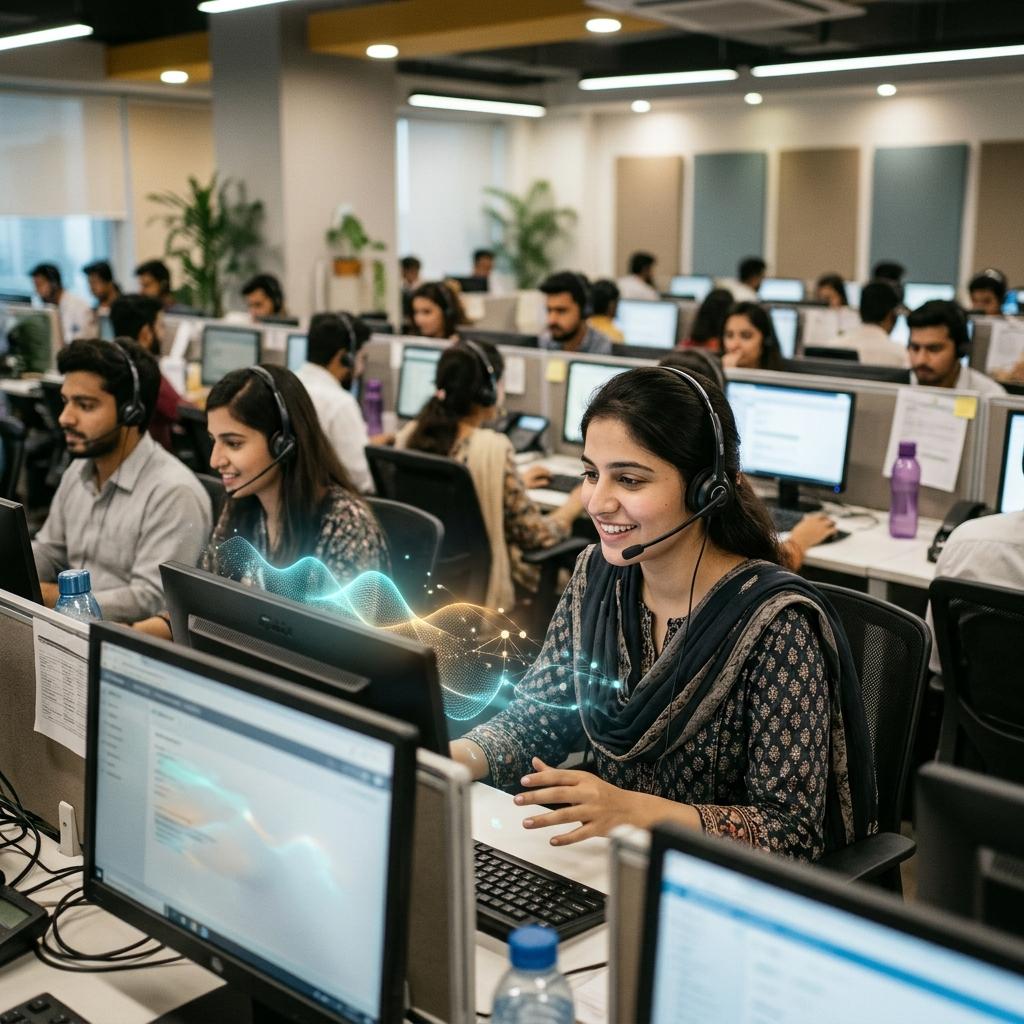
This is a real success story. The sector now has more than 1,000 call centres registered with the Pakistan Software Export Board (plus hundreds more operating), employs over 500,000 people, and serves clients across the US, Western Europe, and the Far East. It positions Pakistan as a competitive outsourcing hub, offering global companies quality customer support and back-office services at lower costs than many alternatives, a genuine, growing source of jobs and foreign exchange. So the boom is real and significant: Pakistan’s BPO sector is thriving, expanding, and earning well. And crucially, industry experts attribute much of this growth to one key factor: the integration of AI into customer-support operations. Which brings us to AI’s central, and complicated, role.
Let’s understand exactly how AI is driving this growth, because it’s a genuinely positive story (for now). AI is making Pakistani call centres more productive, efficient, and capable, which makes them more attractive to global clients.
Here’s how AI helps, concretely. Higher productivity per agent: AI tools (like automated ticket routing, real-time agent assistance that suggests responses, and sentiment analysis during calls) let each human agent handle more calls and resolve issues faster, so firms process higher volumes with the same headcount. Multilingual capability: AI-powered chat and translation let Pakistani BPO firms serve clients in multiple languages, expanding the work they can take on. 24/7 service: AI enables round-the-clock support (chatbots and automation handling off-hours queries), meeting global clients’ always-on expectations. Lower costs and higher efficiency: AI improves operational efficiency and cuts costs, making Pakistani BPO even more cost-competitive. Better quality and scalability: AI tools can improve consistency, data handling, and the ability to scale operations. And new service capabilities: AI lets firms offer more sophisticated, AI-enhanced customer-experience services, moving beyond basic call-handling. So right now, AI is a powerful enabler: it’s making Pakistani call centres more productive, capable, multilingual, efficient, and attractive to international clients, directly driving the export boom. In this phase, AI and human agents work together (AI augmenting humans), and the result is growth. That’s the genuinely positive side of the story, and it’s real. But it’s only half the picture.
Now the harder, essential other side, because the same technology fueling the boom carries a genuine long-term threat. The AI that currently augments Pakistani call-centre agents could, as it advances, increasingly replace them, and even undermine the whole outsourcing model.
Here’s the concern. AI is getting good enough to handle calls on its own: “AI voice agents” (powered by advanced language models, with natural speech and even emotion detection) are now being marketed as able to automate large shares of inbound calls, some claims go as high as 80%, cutting costs and providing 24/7 service without human agents. If AI can handle most routine customer queries directly, the need for large teams of human call-centre agents shrinks. It could reduce the incentive to outsource at all: here’s the deeper threat. Companies outsource call-centre work to places like Pakistan mainly to access cheaper human labour. But if AI can do much of that work directly (and cheaply, from anywhere), the economic incentive to outsource to human agents in Pakistan weakens, a company might just use AI instead of a Pakistani call centre. Analysts have flagged BPO as among the sectors facing growing pressure from AI, precisely because AI could reduce the demand for outsourced labour-intensive services. The jobs at risk are significant: with over 500,000 people employed in the sector, large-scale automation of routine call-handling could threaten many livelihoods over time. So the threat is real and serious: the same AI boosting the sector today could, as it matures, automate much of the routine work, shrink the human workforce needed, and even erode the outsourcing rationale that underpins the sector. This isn’t imminent collapse, but it’s a genuine, growing pressure that can’t be ignored.
Let’s sit with this paradox, because holding both truths together is essential to understanding the situation correctly. It would be easy to tell only one story, “AI is making Pakistani call centres boom!” or “AI will destroy Pakistani call-centre jobs!”, but the honest reality is that both are true, at different stages and in different ways.
Here’s the nuanced picture. Right now (the augmentation phase): AI is primarily augmenting human agents, making them more productive and the sector more competitive, which is driving real growth and export earnings. AI is currently a net positive for the sector’s size and success. Over time (the automation risk): as AI capabilities advance, more of the routine work AI currently assists with could be fully automated, shifting AI from “helping agents” to “replacing agents,” and potentially reducing both jobs and the outsourcing incentive. So it’s not “AI good” or “AI bad”; it’s “AI is currently fueling the boom, but carries a growing automation threat.” The sector is riding an AI-powered wave of growth, while that same AI wave could eventually erode the foundations. This is exactly the kind of nuanced, double-edged dynamic that AI is creating across many industries (as we’ve discussed with service jobs broadly), and the call-centre sector is a vivid example. Understanding both sides, the real current benefit and the real future risk, is essential to responding wisely. Denying either half leads to bad decisions.
So how should Pakistan’s BPO sector respond to this double-edge? The answer isn’t to fear or reject AI (that would forfeit the current boom), nor to ignore the threat, but to use AI strategically to evolve the sector toward higher-value work that’s more defensible against automation. Here’s the constructive path.
Key strategies. Embrace AI as a tool, now: continue adopting AI to stay productive and competitive (rejecting it would cede the advantage to rivals), riding the current boom while it lasts. Move up the value chain: shift from commodity, routine call-handling (most exposed to automation) toward higher-value, more complex services, specialized support, knowledge processes, analytics, consulting, complex problem-solving, and AI-enhanced customer experience, that require human judgment, relationships, and expertise AI can’t easily replace. Become AI-augmented experts, not AI-replaceable agents: position Pakistani workers as skilled professionals who use AI to deliver sophisticated, high-value services, rather than performing routine tasks AI will automate. Offer “AI-enabled BPO” as a service: Pakistan could become a hub for helping global clients implement AI-enhanced customer experience (combining human expertise with AI), a higher-value offering. Diversify into new sectors and services: expand into higher-value BPO segments (finance, healthcare, HR processing, specialized back-office) and new industries, beyond basic customer support. Invest in reskilling: help the 500,000+ workers develop higher-value skills (AI tools, complex problem-solving, specialized domains) so they move into roles AI augments rather than replaces. And focus on what humans do best: emphasize the empathy, complex judgment, relationship-building, and nuanced problem-solving where humans still outperform AI. The through-line: use AI to climb toward higher-value, human-plus-AI services that are more defensible, rather than competing on the commodity call-handling AI will increasingly automate. That’s how the sector turns AI from a threat into a tool for sustainable evolution. Adapt and move up, don’t stand still.
This double-edge carries enormous stakes for Pakistan.
For jobs: with 500,000+ people employed, how AI plays out in BPO will significantly affect a huge number of Pakistani livelihoods, for better (new, higher-value roles) or worse (automated-away routine jobs).
For foreign exchange: the sector’s $300M+ (and growing) export earnings are valuable foreign currency; sustaining and growing this (by moving up the value chain) matters for the economy.
For the AI-and-jobs question: BPO is a vivid, high-stakes example of AI’s double-edged impact on work, a test case for whether Pakistan can harness AI’s benefits while managing its disruption.
For the value-chain imperative: it reinforces the broader lesson (across IT, freelancing, and services) that Pakistan must move up the value chain toward higher-value, less-automatable work, with BPO being an urgent, large-scale case.
The key insight is that Pakistan’s call-centre and BPO sector is enjoying a genuine AI-powered boom that it should fully embrace now, while urgently using that same AI and the current growth to evolve toward higher-value, more automation-resistant work, because the technology fueling today’s success will increasingly threaten the routine jobs at its core. This is a nuanced, two-sided reality that demands a nuanced response, not fear, not complacency, but strategic adaptation. Right now, the boom is real and valuable: AI is making Pakistani call centres more productive, multilingual, efficient, and attractive to global clients, driving exports past $300 million, creating and sustaining jobs, and earning crucial foreign exchange. The sector should ride this wave confidently, continuing to adopt AI to stay competitive, because rejecting AI would simply hand the advantage to rivals and forfeit the growth.
But the honest, essential foresight is that the same AI carries a serious long-term threat: as AI voice agents and automation advance, they could handle much of the routine call-handling directly, shrinking the human workforce needed and even eroding the incentive to outsource to Pakistan at all. With 500,000+ livelihoods involved, this isn’t a risk to ignore. So the strategic imperative is clear: use the current AI-powered boom (and the resources and time it provides) to move the sector decisively up the value chain, toward specialized, complex, knowledge-intensive, relationship-driven, and AI-enhanced services where human expertise (augmented by AI) remains valuable and defensible, rather than competing on the commodity call-handling that AI will increasingly automate. That means investing in reskilling the workforce, diversifying into higher-value BPO segments, positioning Pakistani workers as AI-augmented experts (not AI-replaceable agents), and even offering “AI-enabled BPO” as a sophisticated service to global clients. Done well, Pakistan’s BPO sector can use AI to evolve into a more valuable, resilient, and sustainable industry, turning the double-edge into a net positive. Done passively (riding the commodity boom without adapting), it risks a painful future when automation catches up. The message for the sector, its workers, and policymakers is therefore both optimistic and urgent: enjoy and build on the genuine AI-driven boom, but don’t mistake it for permanence, use this moment to climb higher, toward work AI augments rather than replaces. Ride the wave, but climb. That’s how Pakistan’s call centres turn AI from a looming threat into the engine of a stronger, higher-value future. The time to start that climb is now, while the boom provides the momentum.
Expect AI to keep driving near-term growth in Pakistan’s BPO sector (more productivity, more clients, more exports) while simultaneously advancing toward automating more routine work over time. The crucial question is whether the sector uses this period to move up the value chain (toward higher-value, AI-augmented, less-automatable services) before automation significantly erodes the commodity call-handling base. Watch whether firms diversify, reskill workers, and climb toward sophisticated services, versus riding the commodity wave passively.
If Pakistan’s BPO sector adapts well (embracing AI while evolving toward higher-value work and reskilling its workforce), it could sustain growth and transform into a more valuable, resilient industry even as automation advances, a genuinely positive outcome. If it stands still, it risks disruption as AI automates routine work and erodes the outsourcing incentive. The trajectory depends on proactive adaptation now, while the boom provides momentum and resources. More broadly, this is a key test of Pakistan’s ability to harness AI’s benefits while managing its disruption across its service economy. For the sector’s 500,000+ workers and the economy, getting this evolution right, riding the wave while climbing higher, is genuinely important. The opportunity and the urgency are both real.
Pakistan’s call-centre and BPO sector is living a genuine paradox: it’s booming thanks to AI, with exports crossing $300 million driven significantly by AI-powered customer support that makes Pakistani agents more productive, multilingual, and attractive to global clients, yet that same AI could, over time, automate much of the routine work, shrink the human workforce, and even erode the incentive to outsource to Pakistan at all. Both truths are real: AI is currently the sector’s rocket fuel, and potentially its future disruptor. For an industry employing over 500,000 Pakistanis and earning crucial foreign exchange, this double-edge matters enormously, and demands a wise, nuanced response. The answer isn’t to fear AI (forfeiting the current boom) or ignore the threat (risking painful future disruption), but to do both things at once: ride the AI-powered wave now, while urgently using this moment to climb higher, moving the sector up the value chain toward specialized, complex, knowledge-intensive, relationship-driven, and AI-enhanced services where human expertise augmented by AI stays valuable and defensible, rather than competing on the commodity call-handling AI will increasingly automate. That means embracing AI as a tool, diversifying into higher-value segments, reskilling the workforce into AI-augmented experts, and even offering “AI-enabled BPO” to global clients. Done well, Pakistan’s BPO sector can turn AI’s double-edge into a net positive, evolving into a more valuable, resilient, sustainable industry. Done passively, it risks disruption when automation catches up. So the message is clear and timely: enjoy and build on the boom, but don’t mistake it for permanence. Use this AI-powered moment to climb toward higher-value, more defensible work. Ride the wave, but climb higher, that’s how Pakistan’s call centres secure a stronger future in the AI era. The boom is the opportunity; the climb is the task. Start now.
This article is an analysis and opinion piece for general informational purposes, based on data and reports available in 2026 (including State Bank of Pakistan export figures and industry commentary). Figures (export values, employment, automation potential) are as reported by cited sources and may vary; projections about AI’s future impact are inherently uncertain. This is not business, investment, or career advice; individuals and firms should assess their own situations.
Pakistan’s call-centre and business process outsourcing (BPO) sector is booming, with exports crossing $300 million, but faces a paradox: the same AI fueling the boom could eventually threaten the jobs. Per State Bank of Pakistan data, call-centre/BPO export earnings reached about $322 million in the first eleven months of FY2025-26 (up from $269 million the prior year), and grew further to over $101 million in Q1 FY2026-27 (up ~23.6% year-on-year). The sector has 1,000+ registered call centres, employs over 500,000 people, and serves clients in the US, Western Europe, and the Far East. Industry experts attribute much of the growth to AI integration.
How AI fuels the boom (augmentation phase): AI tools, automated ticket routing, real-time agent assistance (suggesting responses), sentiment analysis during calls, and multilingual AI chat, let agents handle more calls faster, enable 24/7 service, cut costs, improve efficiency, and offer more sophisticated services, making Pakistani BPO more productive and attractive to global clients. AI currently augments human agents, driving growth.
The threat (automation risk): as AI advances, “AI voice agents” (with natural speech, advanced language models, emotion detection) are increasingly able to handle calls directly, some marketed as automating up to 80% of inbound calls. If AI does much of the routine work itself, fewer human agents are needed, and the incentive to outsource to human teams in Pakistan weakens (companies might just use AI). Analysts flag BPO among sectors facing growing AI pressure, as AI reduces demand for outsourced labour-intensive services. With 500,000+ employed, large-scale automation of routine call-handling could threaten many jobs over time.
The paradox: both are true, at different stages. Right now, AI is primarily augmenting agents and driving the boom (net positive). Over time, AI could shift from “helping agents” to “replacing agents,” threatening jobs and the outsourcing model. It’s not “AI good” or “AI bad”, it’s AI fueling today’s boom while carrying a growing automation threat.
What the sector should do (move up the value chain): embrace AI as a tool now (rejecting it cedes advantage); shift from commodity call-handling (most automatable) toward higher-value, complex, less-automatable services (specialized support, knowledge processes, analytics, consulting, AI-enhanced customer experience) requiring human judgment and relationships; position workers as AI-augmented experts, not AI-replaceable agents; offer “AI-enabled BPO” to global clients; diversify into higher-value segments (finance, healthcare, HR); invest in reskilling the 500,000+ workforce; and emphasize human strengths (empathy, complex judgment, relationships).
Takeaway: “Ride the wave, but climb higher.” Pakistan’s BPO sector should fully embrace the genuine AI-powered boom now while urgently using this moment to move up the value chain toward higher-value, automation-resistant work, before AI automates the commodity base. Done well, AI’s double-edge becomes a net positive and a more resilient industry; done passively, it risks disruption. Analysis/opinion; figures as reported; AI-impact projections uncertain; not business/career advice.