A November 2026 study by OpenAI and Upwork found that AI-related freelance projects carry significantly larger budgets, with some analyses citing around 52% higher fixed-price budgets, while hourly rates stayed similar. Demand is shifting toward specialized, multi-task work that bundles AI with skills like video, marketing, and integration. (50 words)
For two years, the message to freelancers has been fear. AI is coming. AI will replace you. AI will make your skills worthless. For Pakistan’s huge freelance workforce, it has been an anxious time.
Now there is hard data, and it tells a more interesting story. A major new study from OpenAI and Upwork, two of the biggest names in AI and freelancing, shows that AI-related freelance projects are actually commanding bigger budgets. The work is not disappearing. It is changing shape, and the money is moving with it. Here is what the study found and what it means for freelancers in Pakistan.
The report comes from OpenAI’s “Work at the Frontier” research series, done with Upwork, and was released in November 2026. It analyzed freelance job postings on Upwork to see how AI is changing what clients ask for and pay.
The headline finding is about money. AI-related projects had larger fixed-price budgets and more hours of work than comparable non-AI projects. Several analyses of the report put the budget difference at around 52% higher. Importantly, the posted hourly rates were similar. That tells us something specific: the extra money is not because AI work pays more per hour, but because AI projects tend to be bigger and broader in scope.
In other words, clients are not paying a premium for the letters “A” and “I.” They are paying more because AI-related jobs now involve doing more, often combining several skills into one project.
The second big finding explains the first. Between early 2023 and late 2025, the mix of tasks in AI-related postings became about 45% more diverse. Jobs went from a smaller set of common tasks to a wider, richer mix.
More importantly, clients started bundling tasks that used to be separate. The report gives an example of a single posting asking for AI-generated video, editing, and motion graphics all together. In the past, those might have been three different gigs for three different freelancers. Now they are one larger project for one capable freelancer, or a small team.
This is the heart of the shift. AI handles the simple, repetitive parts of a task. That frees up budget and expectation for more complex, combined work. The freelancer who can deliver that whole bundle captures a bigger, better-paid project.
The study points to clear directions, even if it does not give a simple winners-and-losers list.
On the rising side, areas like chatbot development, video production, marketing automation, and application integration show up as examples of where AI demand is strong. Video and animation, in particular, make up a larger share of Upwork requests than of everyday ChatGPT use, which suggests real human-plus-AI demand there.
On the weaker side, basic writing is telling. Writing makes up a much larger share of what people do inside ChatGPT than of what they hire freelancers for on Upwork. In plain terms, a lot of simple writing is now being done by AI directly, rather than outsourced to a freelancer. That is a warning for anyone whose entire offer is basic, general-purpose writing.
The pattern across the data is consistent: simple, single, easily-automated tasks are under pressure, while specialized, combined, higher-value work is growing.
This matters enormously for Pakistan, because freelancing is one of the country’s biggest digital success stories. Hundreds of thousands of Pakistanis earn from global platforms, and freelance exports bring in significant foreign earnings.
The study offers Pakistani freelancers a clear and hopeful map. The work is not drying up. It is moving toward bigger, AI-assisted, multi-skill projects that pay more. A Pakistani freelancer who learns to use AI tools and combines them with a real skill, video, design, development, marketing, is positioned to win larger projects than ever before.
The risk is equally clear. Freelancers who offer only the most basic services, the kind AI can now do directly, will feel the squeeze first. For Pakistan’s freelance economy, the message is to move up the value chain quickly, not to compete at the bottom where machines are cheapest.
For the wider economy, this reinforces why Pakistan’s push to train youth in AI skills is well aimed. The future freelance earnings are in AI-plus-skill work, and that is exactly what the country should be preparing its young workforce to do.
It is worth being careful about one thing. The 52% figure is striking, but the study itself is clear that the higher budgets largely reflect bigger project scope, not a magic AI bonus. So the lesson is not “add AI to your profile and charge 52% more.” The lesson is “AI lets you take on bigger, more complete projects, and those pay more.”
The honest read is also balanced. The report explicitly says its findings do not support a simple story of AI replacing freelancers. But it also does not claim AI is harmless. Basic tasks are genuinely moving to AI. Both things are true at once. The freelancers who thrive are the ones who accept that reality and reposition, rather than either panicking or pretending nothing is changing.
For Pakistani freelancers, the single most valuable move is to stop selling individual small tasks and start offering complete, AI-enhanced outcomes. That is where the budgets, and the study, are pointing.
Expect this trend to deepen. As AI tools get better, more of the simple work will be automated, and more of the paid freelance work will be the complex, bundled, human-directed kind. Upwork’s own broader research has pointed to demand for top AI skills rising sharply as AI gets embedded into everyday work.
For Pakistan, the opportunity over the next few years is to help its freelance workforce climb that ladder: from basic gigs to AI-powered specialists who deliver full projects for global clients. The freelancers and training programs that adapt to this now will capture the growth. Those that keep competing on the lowest-value tasks will find that ground shrinking.
The new OpenAI and Upwork data cuts through the fear with something more useful: evidence. AI-related freelance projects are paying more, not because AI is a buzzword, but because the work has grown bigger and more complex, and skilled humans are needed to deliver it.
For Pakistan’s freelancers, this is genuinely good news with a clear condition attached. The money is moving toward those who combine AI with real, specialized skills and deliver complete projects. Learn the tools, level up your craft, and offer more than a single task. Do that, and the shift the study describes works in your favor instead of against you.
This article is for general information only and is not career or financial advice. Study findings are based on reported data and interpretations may vary.
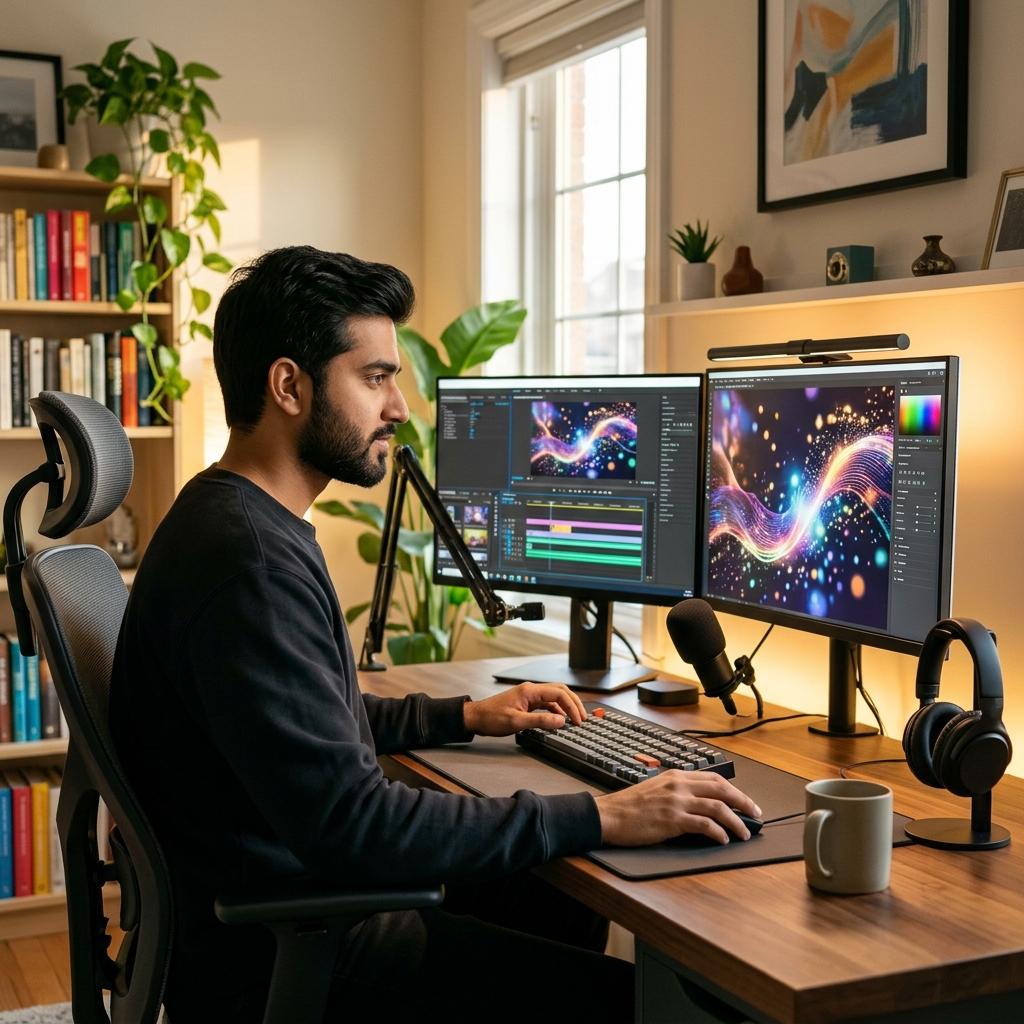
A photorealistic, aspirational scene of a young Pakistani freelancer working at a modern home setup with dual monitors, one screen showing abstract AI-assisted creative work such as flowing video edits and design elements represented as soft glowing visuals. The person looks focused and successful, confident posture, surrounded by a clean, well-lit workspace suggesting rising income and opportunity. Warm, optimistic lighting. The mood conveys growth and capability in the AI era. Absolutely no text, no words, no numbers, no logos, and no branding anywhere in the image. Photorealistic, high detail, natural colors.