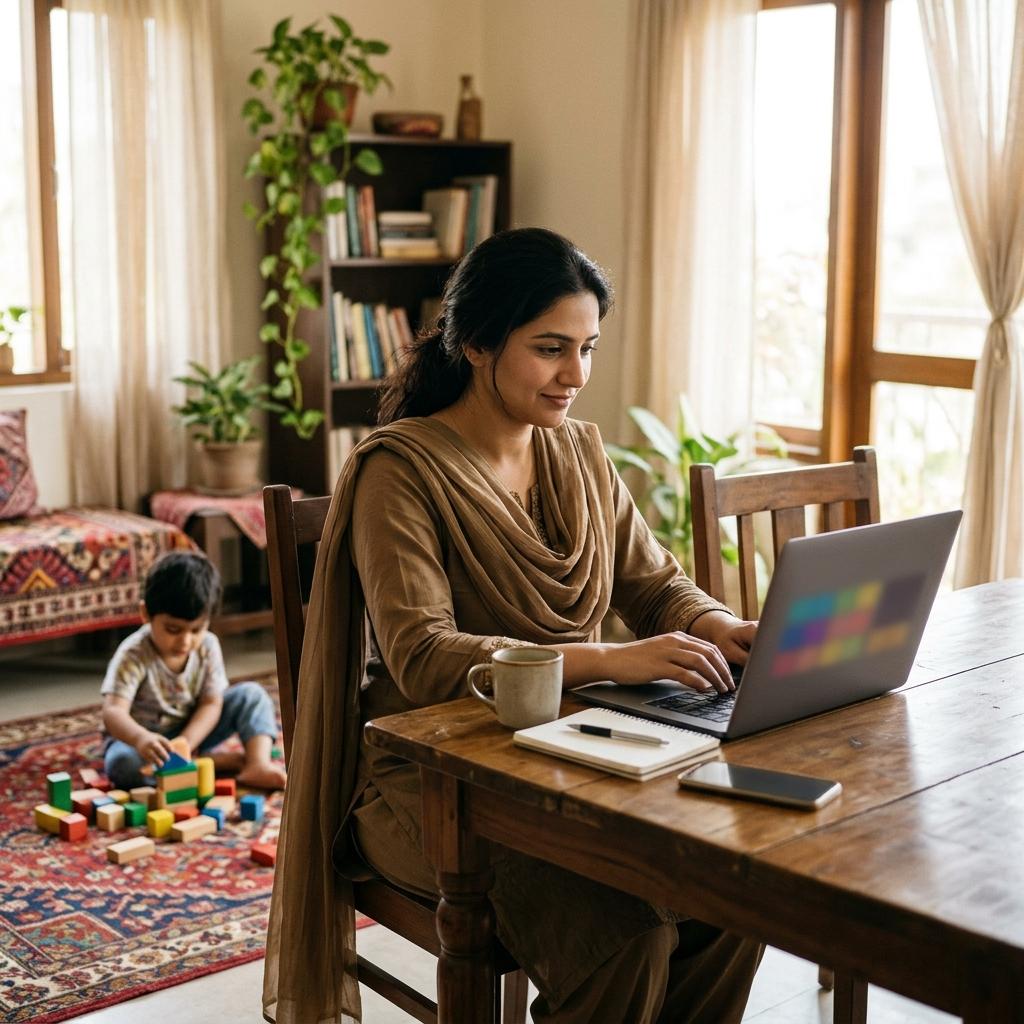
Pakistan’s female labour-force participation is around 24.6%, among the world’s lowest. Remote and online work (freelancing, digital jobs, home-based businesses) could be a powerful way to bring millions of women into the economy, since it fits around family responsibilities and social or mobility constraints. But connectivity and access alone aren’t enough: deeper barriers (skills, safety, confidence, support) must also be addressed.
Here’s a statistic that reveals one of Pakistan’s biggest untapped opportunities: only around a quarter of Pakistani women participate in the formal labour force (female labour-force participation is roughly 24.6%, one of the lowest rates in the world). That means the talents, skills, and economic potential of a huge portion of Pakistan’s population, half its people, are largely left out of the economy. Changing that wouldn’t just be good for women; it would be transformative for Pakistan’s whole economy (as we’ve discussed, women’s economic participation has an outsized multiplier effect).
So how do you bring more Pakistani women into the workforce, given the real social, cultural, mobility, and family constraints many face? Here’s a genuinely promising answer: remote and online work. Freelancing, digital jobs, and home-based online businesses could be a powerful way to open economic opportunity to millions of women who can’t easily access traditional workplaces. But, and this is crucial, simply giving women internet access and devices isn’t enough; connectivity alone won’t empower them. Deeper barriers must be addressed too. Here’s an honest look at why remote work is such an opportunity for Pakistani women, and the one big thing (really, a set of things) we must fix to actually realize it.
Let’s start with the scale of the challenge, and the opportunity, because it’s genuinely significant. Pakistan has one of the lowest female labour-force participation rates in the world, at around 24.6%. This means roughly three-quarters of Pakistani women are not in the formal workforce, their skills and potential largely untapped economically.
This matters enormously, for several reasons. It’s a massive loss of economic potential: a country that leaves most of half its population out of the economy is operating far below its capacity; engaging more women would significantly boost Pakistan’s growth, productivity, and development. It’s a loss for women themselves: economic participation brings income, independence, dignity, and opportunity, which many women are denied. And it reflects real barriers: women’s low participation isn’t about lack of ability or desire; it’s about genuine obstacles, social and cultural expectations, family and childcare responsibilities, limited mobility and safety concerns, workplace barriers, and more, that make traditional employment hard or impossible for many. So the “problem” is really a huge, under-recognized opportunity: Pakistan has an enormous pool of untapped female talent and potential, held back not by inability but by barriers. Finding ways to bring more women into economic activity, around those barriers, could unlock tremendous value for women and the country alike. And that’s exactly where remote work comes in as a genuinely promising solution.
Here’s why remote and online work is such a compelling answer, because it’s uniquely suited to overcoming many of the barriers that keep Pakistani women out of traditional employment. It fits women’s realities in ways conventional workplaces often don’t.
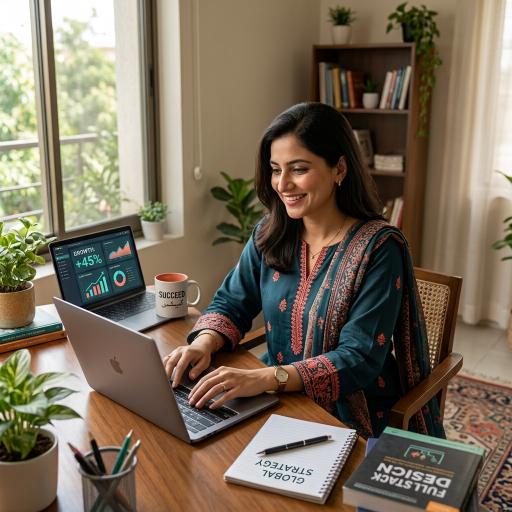
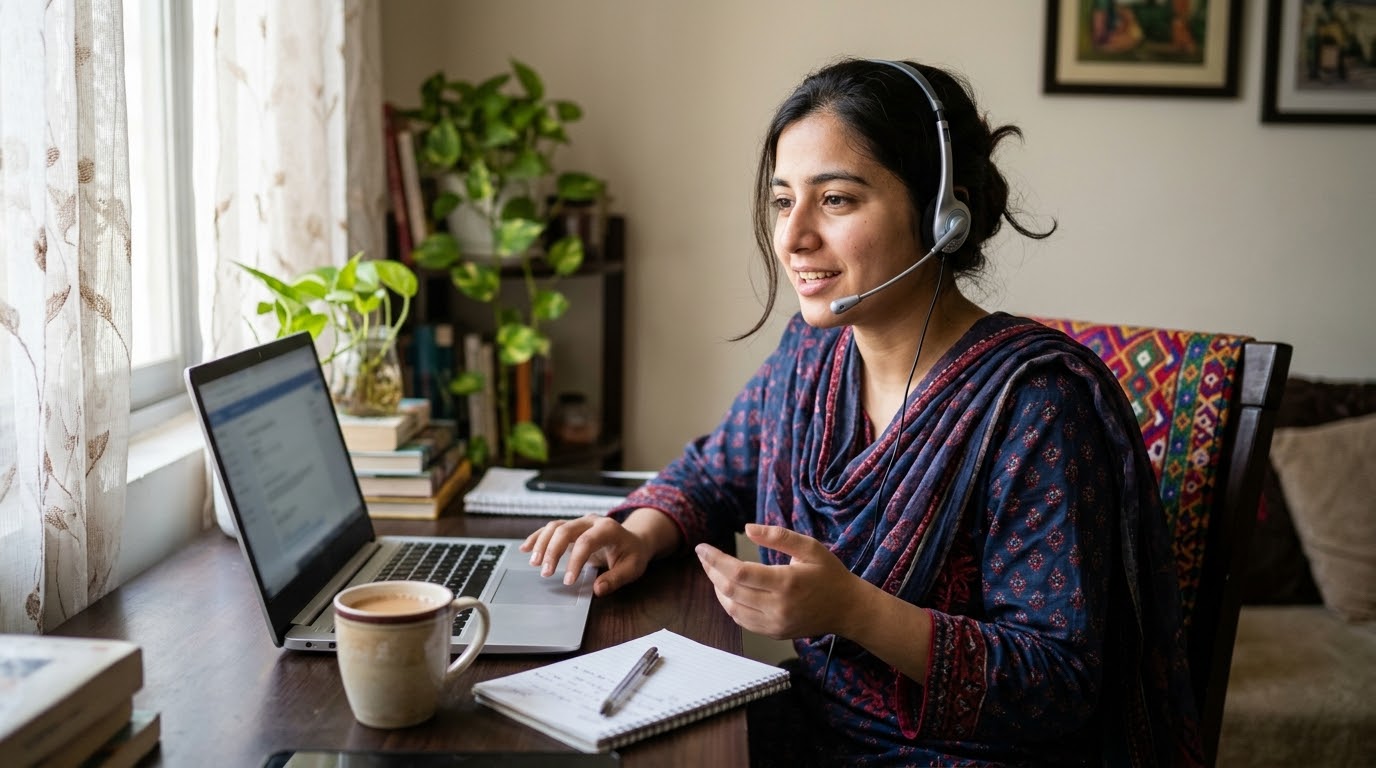
Consider how well it fits. Flexibility around responsibilities: remote work lets women work around family and childcare responsibilities (which disproportionately fall on them), on flexible schedules, from home, making earning possible when a rigid office job wouldn’t be. Working from home: by eliminating the need to travel to a workplace, remote work removes major barriers, mobility constraints, safety concerns, transport difficulties, and social restrictions on women working outside the home, that keep many women from traditional jobs. Reduced social/cultural friction: for families or communities with reservations about women working in traditional (often mixed) workplaces, home-based online work can be more acceptable, opening a door that would otherwise stay closed. Autonomy and safety: working from home can feel safer and more comfortable for many women, free from workplace harassment or difficult commutes. Accessibility across geography: women in smaller cities and rural areas (far from job opportunities) can access remote work that connects them to clients and employers anywhere. Scalability of opportunity: freelancing, digital services, online businesses, and remote jobs offer a wide range of accessible options (many not requiring advanced technical skills). And proven potential: many Pakistani women have already built successful freelancing careers and online businesses from home (as we’ve covered), showing it genuinely works. So remote work is a genuine, well-matched opportunity: it lets women participate economically without having to overcome every barrier of traditional employment at once, meeting them where they are. For bringing women into Pakistan’s economy, it’s one of the most promising levers available. The fit is real and powerful.
Now the crucial, honest caveat, and it’s the heart of this article. There’s a common, well-meaning assumption that if we just give women internet access and devices, they’ll be empowered to work online. But that’s not enough. Connectivity alone won’t empower women, because the barriers go deeper than access.
Here’s the reality. Giving a woman a smartphone and internet is necessary but far from sufficient. For her to actually earn through remote work, many other things need to be in place, and often aren’t. She needs digital skills: knowing how to use the internet isn’t the same as having marketable skills (freelancing abilities, digital services, online business know-how); without skills and training, access alone yields little. She needs confidence and knowledge: many women don’t know these opportunities exist, how to start, or believe they can do it; awareness, guidance, and confidence are essential. She needs safety and a safe online environment: women face online harassment and safety risks (as we’ve discussed regarding online safety), which can deter or harm them; a safe digital environment matters. She needs family and social support: if her family doesn’t support her working (even from home), or she’s overloaded with domestic duties with no time, access won’t translate into work. She needs to overcome the “double burden”: women often carry the full load of domestic and care work, leaving little time/energy for earning, even from home. She needs payment and practical enablers: ways to get paid, manage work, and handle the practicalities. And she needs role models and community: seeing other women succeed, and having support networks, hugely increases the chance she’ll try and persist. So the honest truth is that access/connectivity is just the starting point; real empowerment requires addressing this fuller set of barriers, skills, confidence, safety, support, time, and practical enablers. Just “connecting” women, without the rest, won’t bring them into the economy. This is the “one thing” (really, this set of things) we must fix.
So what does it genuinely take to turn remote work’s potential into reality for Pakistani women? Let’s be concrete, because the solutions follow directly from the barriers. A holistic approach is needed.
Key enablers. Skills training (crucial): provide accessible, practical digital-skills and freelancing training designed for women (many programs, like DigiSkills and women-focused initiatives, do this), so access becomes capability. Awareness and guidance: actively inform women that these opportunities exist, show them how to start, and guide them through the early steps. Build confidence and role models: showcase successful women (relatable role models), mentor, and encourage, to build belief and persistence. Ensure online safety: promote safe online practices and environments, and protect women from harassment, so they can work without fear. Engage families and communities: work to build family and community support for women’s home-based work (since this is often decisive), framing it positively. Address the time/double-burden issue: recognize and help manage the domestic-duty overload (through support, awareness, and flexible options). Provide practical enablers: accessible devices and connectivity (necessary, not sufficient), payment solutions, supportive platforms, and communities. And create supportive ecosystems: women-focused freelancing communities, mentorship networks, and support groups dramatically improve success. The through-line: go beyond just “giving access” to building the full enabling environment, skills, confidence, safety, support, and practical help, that lets women actually succeed in remote work. This is more work than simply distributing devices or connectivity, but it’s what genuinely empowers women economically. Access opens the door; this fuller support actually walks women through it. That’s the real task.
Let’s be clear about why this matters so much, because the payoff is enormous, for women, for Pakistan, for everyone. Bringing more women into the economy through remote work (done right) would deliver profound benefits.
Consider the impact. Transformed lives: income and economic participation give women independence, dignity, confidence, and opportunity, transforming their lives and those of their families. The multiplier effect: as we’ve discussed, women reinvest the vast majority of their income into their families and communities (children’s education, health, nutrition), so empowering women economically has an outsized positive ripple effect on development. Huge economic gain: engaging even a fraction of Pakistan’s untapped female workforce would significantly boost the economy, productivity, growth, and foreign exchange (through freelancing/remote work). Social progress: women’s economic empowerment drives broader positive change, challenging barriers and expanding opportunity across society. And generational impact: empowered, earning mothers often raise more empowered, educated children, benefiting future generations. So this isn’t a niche or “women’s issue”; it’s one of the highest-return opportunities for Pakistan’s development, economic and social. Remote work offers a genuinely promising, well-matched path to unlock it, for millions of women who are currently left out. That’s why addressing the barriers, and getting this right, is worth every effort. The potential prize, for women and for Pakistan, is immense.
This opportunity carries profound significance.
For the economy: bringing more women into economic participation through remote work could significantly boost Pakistan’s growth, productivity, and foreign-exchange earnings, tapping a huge underused resource.
For women and families: it offers income, independence, and dignity to women, with outsized benefits for families and communities given women’s reinvestment patterns.
For inclusion and equity: remote work can reach women facing social, geographic, or mobility barriers, making economic opportunity more inclusive and helping bridge Pakistan’s gender gap.
For the digital economy: more women in freelancing, digital work, and online business strengthens and expands Pakistan’s whole digital economy, a win for the sector and the country.
The key insight is that remote and online work represents a genuinely powerful, well-matched opportunity to bring millions of Pakistani women into the economy, around the real barriers that keep them out of traditional employment, but realizing that potential requires recognizing that connectivity and access alone are not enough; we must address the fuller set of barriers (skills, confidence, safety, family support, time, and practical enablers) that stand between a connected woman and actual economic empowerment. The opportunity is real and important: with female labour-force participation around 24.6%, one of the world’s lowest, Pakistan is leaving enormous talent and potential untapped, and remote work, with its flexibility, home-based nature, and reduced mobility/social friction, is uniquely suited to opening economic doors for women who can’t easily access conventional workplaces. Many Pakistani women have already proven it works. So the promise is genuine and the prize, given women’s outsized economic and social multiplier effect, is immense.
But the honest, essential wisdom is that we must not mistake access for empowerment. The well-meaning assumption that “just give women internet and devices and they’ll be empowered” is insufficient; connectivity is necessary but far from enough. A woman also needs marketable skills, awareness that opportunities exist, confidence and role models, a safe online environment, family and community support, relief from the double burden of domestic work, and practical enablers like payment solutions and supportive communities. Address only access, and most women still won’t be able to participate; address the full set, and millions could. So the path forward is holistic: pair connectivity with practical skills training (designed for women), awareness and guidance, confidence-building and role models, online safety, family and community engagement, support with the domestic-duty overload, and women-focused ecosystems and mentorship. This is more demanding than distributing devices, but it’s what genuinely works, and it’s worth every effort, because few things would benefit Pakistan more than unlocking the economic potential of its women. For individuals, communities, organizations, and policymakers, the message is clear: remote work can be a transformative engine for women’s economic empowerment in Pakistan, but only if we go beyond “giving access” to building the full enabling environment that lets women actually succeed. Access is the start, not the solution. Build the rest, and remote work could bring millions of Pakistani women, and their immense untapped potential, into the economy, transforming their lives, their families, and the country. That’s a goal genuinely worth striving for, with the honesty to do it properly.
Expect remote work to remain a key potential pathway for women’s economic participation in Pakistan, with growing recognition that access must be paired with skills, support, and enabling conditions to actually empower women. Watch whether efforts increasingly address the fuller set of barriers (not just connectivity), through women-focused skills programs, safe digital environments, family/community engagement, and supportive ecosystems, which would meaningfully raise women’s participation.
If Pakistan takes a holistic approach, pairing access with the full enabling environment, remote work could progressively bring far more women into the economy, delivering major economic and social gains. If efforts stop at “providing access” without the rest, the potential will remain largely unrealized. The trajectory depends on moving beyond connectivity to comprehensive empowerment. The encouraging reality is that the opportunity is real, the approach is known, and the payoff is immense; the task is to do it properly. For Pakistan’s women and economy, getting this right, using remote work, supported holistically, to unlock women’s vast untapped potential, is one of the most consequential and hopeful opportunities ahead. The door is there; the task is to help women truly walk through it.
Pakistan leaves one of its greatest resources, the talent and potential of its women, largely untapped, with female labour-force participation among the world’s lowest at around 24.6%. Remote and online work offers a genuinely powerful, well-matched way to change that: by providing flexibility, home-based options, and reduced mobility and social barriers, it can open economic opportunity to millions of women who can’t easily access traditional workplaces, around the very constraints that hold them back. Many Pakistani women have already proven it works, and given women’s outsized economic and social multiplier effect, the potential prize is immense, for women, families, and the whole country. But the essential, honest truth is that connectivity alone won’t empower women. Simply giving women internet access and devices isn’t enough; deeper barriers must be addressed too, marketable skills, awareness and confidence, online safety, family and community support, relief from the domestic double burden, and practical enablers. Address only access, and most women still can’t participate; address the full set, and millions could. So the path forward is holistic: pair connectivity with women-focused skills training, awareness, role models, safety, family engagement, and supportive ecosystems, going beyond “giving access” to building the full enabling environment that lets women actually succeed. It’s more demanding than distributing devices, but it’s what genuinely works, and few things would benefit Pakistan more. Remote work could bring millions of Pakistani women into the economy, transforming lives and uplifting the nation, if we fix not just access, but the whole set of barriers around it. Access is the start; the real work is building everything else. Let’s do it properly, and unlock the immense potential of Pakistan’s women. The opportunity is real, the approach is clear, and the prize is one of the most valuable Pakistan could win.
This article is an analysis and opinion piece for general informational purposes, based on data and reports available in 2026 (including female labour-force-participation figures cited from sources like the World Bank). Figures are as reported and may vary by source and methodology. This article discusses women’s economic participation respectfully and constructively. This is not professional, career, or policy advice; individual circumstances vary, and appropriate guidance should be sought as needed.
Pakistan has one of the world’s lowest female labour-force participation rates, around 24.6% (World Bank), meaning roughly three-quarters of Pakistani women are outside the formal workforce, their talent and economic potential largely untapped. This isn’t due to lack of ability or desire, but genuine barriers: social/cultural expectations, family and childcare responsibilities (disproportionately on women), limited mobility and safety concerns, restrictions on working outside the home, and workplace barriers.
Remote and online work (freelancing, digital jobs, home-based online businesses) is a genuinely powerful, well-matched opportunity to bring women into the economy, because it fits around these barriers: it offers flexibility around family/childcare responsibilities; lets women work from home (removing mobility, safety, transport, and social barriers to working outside); can be more socially acceptable to families; feels safer; reaches women in smaller cities and rural areas; and offers many accessible options (not all requiring advanced skills). Many Pakistani women have already built successful freelancing careers and online businesses from home, proving it works. Given women’s outsized economic/social multiplier effect (women reinvest most income into families/communities), the potential prize is immense.
The crucial catch: connectivity and access alone won’t empower women. The well-meaning assumption that “just give women internet and devices and they’ll be empowered” is insufficient. For a woman to actually earn through remote work, she also needs: marketable digital/freelancing skills (access isn’t the same as capability); awareness that opportunities exist and how to start; confidence and role models; a safe online environment (free from harassment); family and community support; relief from the “double burden” of domestic/care work (which leaves little time/energy); and practical enablers (payment solutions, supportive platforms/communities). Address only access, and most women still can’t participate; address the full set, and millions could.
What it takes (holistic approach): accessible, practical, women-focused digital-skills and freelancing training; awareness and guidance; confidence-building and relatable role models; online safety; family and community engagement; help managing the domestic double burden; practical enablers (devices, connectivity, payments); and women-focused ecosystems and mentorship. This is more demanding than distributing devices, but it’s what genuinely empowers women.
Why it matters: it transforms women’s lives (income, independence, dignity); has an outsized multiplier effect on development; would significantly boost Pakistan’s economy, productivity, growth, and foreign exchange by tapping a huge underused resource; drives social progress; and has generational impact. It’s one of Pakistan’s highest-return development opportunities.
Takeaway: “Access is the start, not the solution.” Remote work can be a transformative engine for women’s economic empowerment in Pakistan, but only if we go beyond “giving access” to building the full enabling environment (skills, confidence, safety, support, practical help) that lets women actually succeed. Fix that whole set of barriers, and remote work could bring millions of Pakistani women, and their immense untapped potential, into the economy. Analysis/opinion; figures (e.g., ~24.6% participation) as reported and vary by source; respectful and constructive; not professional/policy advice.